

How to Negotiate a Car Price: A Practical Guide for Buyers
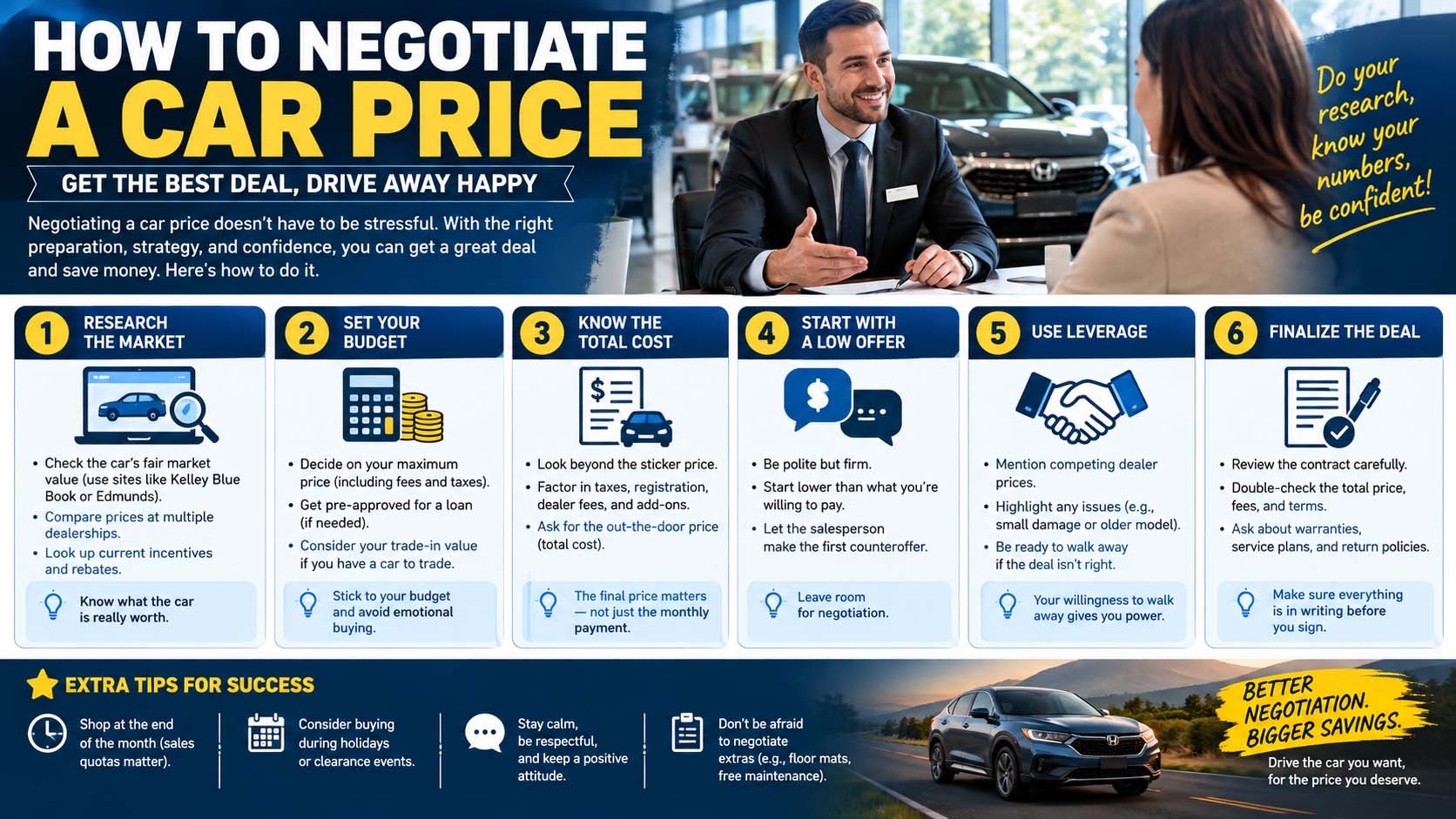
Buying a car can feel exciting until the conversation turns to price. Fortunately, learning how to negotiate a car price can help you approach the deal with confidence instead of simply accepting the first number you see. The key is to research the vehicle’s market value, separate the car price from financing and trade-in discussions, and know exactly how much you are willing to pay before negotiations begin.
Whether you are shopping for a brand-new vehicle or a used car, preparation gives you leverage. Dealers negotiate every day, while most shoppers buy a vehicle only occasionally. Therefore, having a simple strategy before you walk into a dealership can make the process much easier.
Research the Car Before Talking About Price
Good negotiation starts before you speak with a salesperson. First, identify the exact model, trim, engine, options, and features you want. Then, compare similar vehicles from several sellers.
Look at advertised prices in your area rather than relying on a single listing. Prices can vary based on location, mileage, condition, inventory, vehicle history, options, and local demand.
For a new vehicle, compare the manufacturer’s suggested retail price with actual dealer listings. Also, check whether the manufacturer currently offers incentives or rebates that apply to you.
For a used vehicle, compare cars with similar model years, mileage, trim levels, equipment, and condition. A five-year-old vehicle with 30,000 miles should not automatically be compared with the same model showing 90,000 miles.
This preparation is similar to researching how to ask for a raise: knowing the market value gives you a stronger basis for asking for a better number instead of relying on guesswork.
How to Negotiate a Car Price Before Visiting the Dealer
You do not necessarily need to begin negotiating inside the showroom. In fact, contacting several dealerships before visiting can make comparison shopping easier.
Ideally, request an itemized quote showing the vehicle price and dealer-added charges.
However, make sure you are comparing equivalent offers. One dealership may advertise a lower starting price but add accessories or fees later.
Then, ask each seller for their competitive price.
When one dealer provides a strong quote, you can ask another whether they can beat it. As a result, dealerships compete for your business instead of you negotiating against only one seller.
Focus on the Out-the-Door Price
One of the most useful numbers during negotiations is the out-the-door price. This represents the total amount required to purchase the vehicle, including the negotiated selling price plus applicable taxes, registration costs, and dealer fees.
Ask for a written breakdown whenever possible.
Otherwise, a dealer could agree to lower the advertised vehicle price while adding other fees and charges that make the final purchase significantly more expensive.
Taxes and government fees generally are not negotiable. However, dealer-controlled fees, optional products, accessories, and add-ons deserve closer attention.
Decide Your Budget Before Negotiating
Set three numbers before starting serious negotiations: your preferred price, an acceptable price, and the maximum amount you will pay.
Your maximum should remain private.
If a salesperson knows your absolute limit, negotiations may naturally move toward that number. Instead, base your opening offer on your research and the vehicle’s realistic market value.
Also, consider the total cost of ownership. Insurance, fuel, maintenance, repairs, registration, and financing can make an affordable-looking vehicle expensive over time.
Therefore, avoid using your entire budget just to cover the purchase price.
Seasonal timing can influence many large purchases. For example, shoppers researching the best time of year to buy appliances often compare promotions and inventory cycles, and car buyers can use a similar mindset by watching manufacturer incentives and local dealer inventory.
How to Negotiate a New Car Price
Understanding how to negotiate a new car price starts with recognizing that MSRP is a reference point rather than automatically the final selling price.
Research comparable new vehicles at several dealerships. Then, check available manufacturer incentives and identify which offers you actually qualify for.
When you begin negotiating, discuss the vehicle’s selling price first. Avoid letting the conversation immediately shift toward monthly payments.
For example, instead of saying, “I need my payment below $500,” discuss the total vehicle price. A dealer can potentially create a lower monthly payment by extending the loan term, which may increase the total interest you pay.
Once you agree on the car’s price, you can evaluate financing separately.
Ask About Dealer Add-Ons
Some new vehicles come with dealer-installed accessories or optional packages. These might include paint protection, wheel protection, security products, nitrogen-filled tires, appearance packages, or other extras.
Decide whether each product provides value to you.
If you do not want an optional product, ask whether it can be removed from the deal. If an accessory is already installed and cannot easily be removed, you can still ask whether its price is negotiable.
However, availability and dealer policies vary, so removal or discounts are not guaranteed.
How to Negotiate a Used Car Price
Learning how to negotiate a used car price requires more attention to the individual vehicle because no two used cars have exactly the same history and condition.
Start with comparable listings. Then, consider mileage, maintenance records, accident history, tire condition, cosmetic damage, ownership history, and mechanical condition.
A vehicle history report can provide useful background information. However, it should not replace an independent inspection.
For many buyers, paying a qualified independent mechanic to perform a pre-purchase inspection is worthwhile. The inspection may identify worn brakes, leaking components, suspension problems, damaged tires, or other issues that are difficult to spot during a quick test drive.
If the inspection finds legitimate problems, you can use estimated repair costs when discussing the price.
For example, rather than simply saying, “The car costs too much,” you could point out that the tires need replacement soon and explain that your offer reflects that expense.
How to Negotiate a Used Car Price at a Dealership
When learning how to negotiate a used car price at a dealership, remember that the advertised price is only one part of the transaction.
First, ask for the complete out-the-door price. Then, review every charge before discussing financing or a trade-in.
Next, compare the dealership’s price with similar vehicles nearby. If comparable cars cost less, show the salesperson the evidence and make a reasonable offer.
Used-car inventory can differ significantly from one dealer to another. Therefore, your negotiating leverage may depend on how common the vehicle is and how many alternatives are available.
If several similar cars are for sale nearby, you can comfortably walk away from a weak deal. On the other hand, a rare model in excellent condition may leave less room for negotiation.
Keep Financing Separate From the Vehicle Price
Financing deserves its own negotiation.
Before visiting a dealership, consider getting preapproved through a bank or credit union. A preapproval gives you a financing benchmark and helps you understand what interest rate and loan terms may be available to you.
Then, allow the dealership to present its financing offer if you want to compare.
A dealership may sometimes provide competitive manufacturer-backed financing or other options. However, compare the annual percentage rate, loan term, amount financed, and total cost rather than looking only at the monthly payment.
A longer loan term can reduce the monthly payment while increasing the amount of interest paid over time.
Therefore, negotiate the car price first and financing second.
Handle Your Trade-In as a Separate Deal
If you are trading in your current vehicle, research its approximate value before arriving.
Get estimates from multiple sources if practical. That way, you have a reference point when the dealership makes an offer.
Ideally, agree on the new vehicle’s price before finalizing the trade-in value. Keeping the two discussions separate makes it easier to understand whether you are actually receiving a good deal.
Otherwise, a generous-looking trade-in allowance might be offset by a higher vehicle price.
The same comparison-shopping principle applies to other expensive purchases. Someone researching the best time to buy furniture, for instance, benefits from comparing the actual final cost rather than being distracted by the size of an advertised discount.
How to Negotiate for a Car Price Without Feeling Uncomfortable
Many shoppers dislike negotiating because they worry about appearing confrontational. However, good negotiation does not require arguing.
Stay polite, calm, and specific.
Instead of saying, “That’s way too expensive,” explain why your offer makes sense. You might reference comparable listings, vehicle condition, or a written quote from another dealer.
After making an offer, give the salesperson time to respond. You do not need to immediately increase your offer just because there is silence.
Also, avoid becoming emotionally committed to one vehicle. Being willing to leave gives you much more control over the buying process.
If the deal does not fit your budget, thank the salesperson and walk away. You can always reconsider later if the offer changes.
Watch for Discounts That Have Conditions
A large advertised discount may look impressive, yet not every shopper necessarily qualifies for every incentive.
For instance, some offers may depend on financing through a particular lender, owning a competing vehicle, being a recent graduate, serving in the military, or meeting another eligibility requirement.
Therefore, ask which discounts are included in the advertised price.
This is especially useful when an advertisement resembles what is a flash sale pricing, where urgency and a large headline discount can encourage shoppers to focus on the promotion rather than the final terms.
Always compare the actual price you qualify for.
Common Car Negotiation Mistakes
Even prepared buyers can weaken their position by making a few avoidable mistakes.
| Mistake | Better Approach |
|---|---|
| Negotiating only the monthly payment | Negotiate the vehicle price first |
| Shopping at only one dealer | Compare multiple sellers |
| Revealing your maximum budget early | Keep your limit private |
| Ignoring dealer fees | Request an itemized out-the-door quote |
| Skipping a used-car inspection | Consider an independent pre-purchase inspection |
| Combining price, financing and trade-in immediately | Evaluate each part separately |
| Buying because of pressure | Be prepared to walk away |
Another mistake is assuming every fee is negotiable. Taxes, title fees, and government registration charges generally are not controlled by the dealership. Therefore, focus your negotiation on costs the seller can actually change.
A Simple Car Price Negotiation Checklist
Before agreeing to buy, make sure you have:
- Researched comparable vehicles in your area
- Determined your preferred and maximum prices
- Compared quotes from multiple dealerships
- Requested the out-the-door price
- Reviewed dealer fees and optional add-ons
- Compared financing offers
- Researched your trade-in separately
- Test-driven the vehicle
- Considered an independent inspection for a used car
- Read the purchase documents before signing
Most of these steps can be completed before you become emotionally invested in a particular vehicle.
Frequently Asked Questions
How much lower should I offer when negotiating a car?
There is no percentage that works for every vehicle. Instead, base your offer on comparable local prices, condition, mileage, incentives, and current inventory. A realistic, evidence-based offer usually gives you a stronger starting point than an arbitrary low number.
Can you negotiate the price of a new car?
Often, yes, although the amount of flexibility varies by vehicle, dealership, inventory, demand, and available incentives. Some high-demand models may have very little negotiating room.
Can you negotiate used-car prices?
Often, yes. However, the vehicle’s condition, mileage, market value, local supply, and dealer pricing strategy affect how much flexibility exists.
Should I tell a dealer I am paying cash?
You do not need to make payment method the focus of your initial price negotiation. First, negotiate the vehicle price. Then, compare available financing or cash-payment options based on their actual costs and terms.
Is the end of the month always the best time to buy?
Not necessarily. A salesperson or dealership may have sales targets, but buyers cannot assume a better deal will always appear at month-end. Inventory, manufacturer incentives, demand, and competing dealer offers can matter more.
Make the Final Number Your Priority
Knowing how to negotiate a car price is less about being an aggressive negotiator and more about arriving prepared. Research the market, compare several sellers, focus on the out-the-door price, and separate the vehicle price from financing and trade-in discussions.
Another vehicle or another offer may be available, while accepting a deal you do not fully understand can leave you paying more than you intended.
Once the numbers make sense, review every document carefully before signing. A good car purchase is not simply the lowest advertised price; it is a vehicle that meets your needs at a total cost you understand and can comfortably afford.
