
Best Time to Buy Furniture: Best Months, Sales, and Shopping Tips
Furniture can be a major household expense, so a little patience can make a noticeable difference to your budget. The best time to buy furniture often falls around seasonal inventory changes, holiday sales, and clearance periods. However, the ideal month also depends on whether you are shopping for indoor furniture, outdoor pieces, a mattress, or something you need immediately.
Instead of waiting for one magical sale date, it helps to understand how furniture retailers rotate inventory. New collections arrive throughout the year, which can push older styles into clearance. Meanwhile, major shopping weekends create another chance to find lower prices.
The right strategy combines good timing with careful comparison. After all, a cheap sofa that does not fit your room or lifestyle is not a good deal.
When Is the Best Time to Buy Furniture?
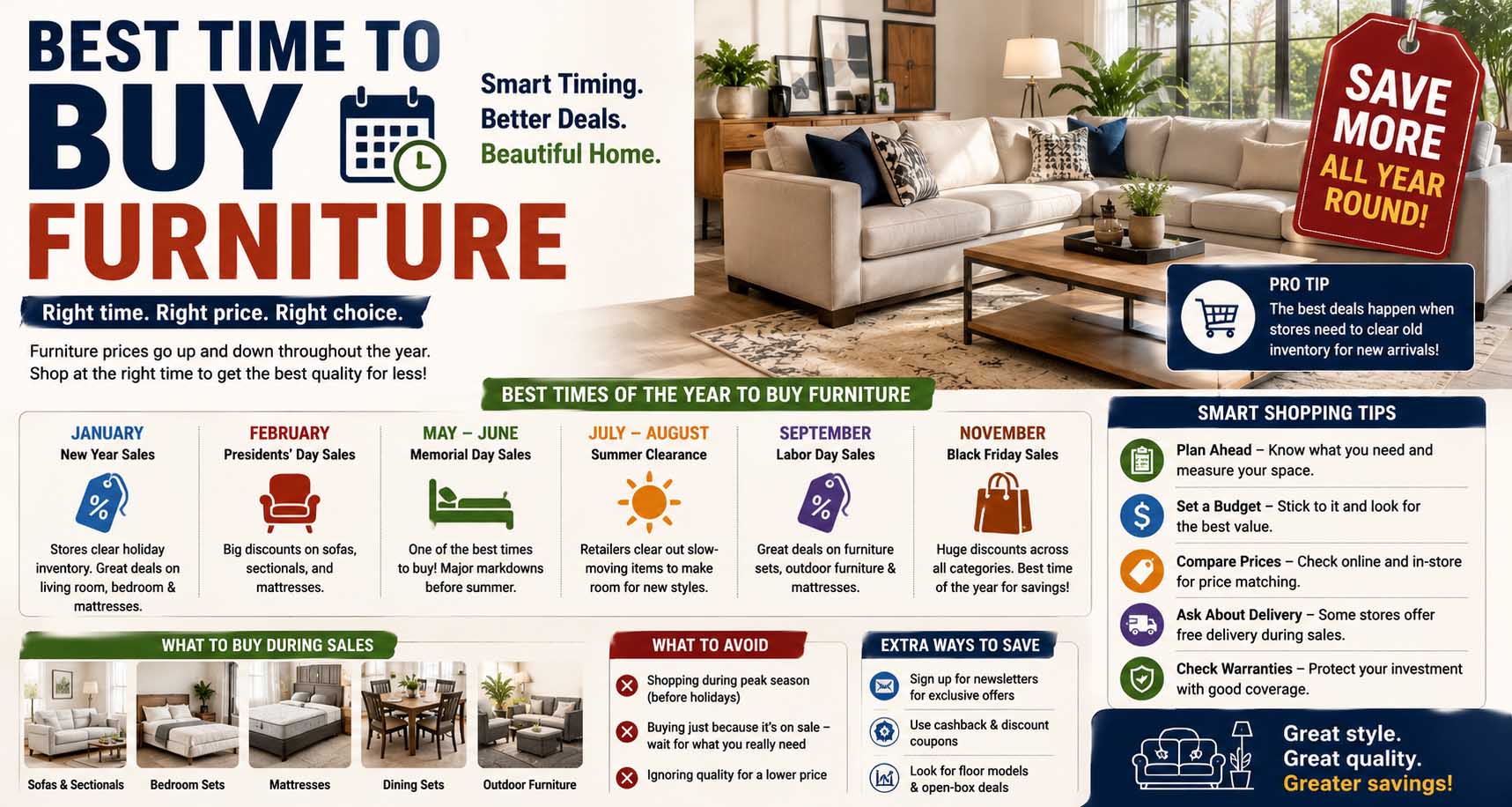
If you are wondering when is the best time to buy furniture, start by separating indoor and outdoor pieces. Indoor furniture often sees attractive clearance opportunities around the periods when retailers prepare for new collections, while outdoor furniture commonly becomes cheaper toward the end of summer.
Holiday weekends can also bring broad promotions. Presidents’ Day, Memorial Day, Labor Day, Black Friday, and other major retail events frequently feature furniture sales in the U.S., although exact promotions vary from store to store and year to year.
January can also be worth watching because retailers may clear older merchandise after the holiday shopping season. Meanwhile, late summer can be particularly useful for shoppers furnishing patios and outdoor spaces.
Therefore, your best buying window depends as much on what you need as when you shop.
Best Time of Year to Buy Furniture at a Glance
Although retailers follow their own schedules, certain parts of the year tend to provide more opportunities than others.
| Shopping Period | What to Watch For | Good For |
|---|---|---|
| January–February | Post-holiday clearance, seasonal promotions | Sofas, tables, bedroom furniture |
| May | Memorial Day promotions | Indoor and outdoor furniture |
| July–August | Seasonal clearance | Indoor furniture and selected floor models |
| August–September | Outdoor inventory reductions | Patio furniture |
| September | Labor Day promotions | Sofas, dining sets, bedroom pieces |
| November | Black Friday sales | Broad furniture categories |
| December | Holiday and year-end promotions | Selected clearance items |
These are general shopping patterns rather than guaranteed discount periods. Prices and inventory vary depending on the retailer, brand, location, product category, and year.
Because of that, start watching prices before the sale begins. You will then have a better idea whether the advertised discount represents meaningful savings.
Why Furniture Prices Change During the Year
Furniture stores have limited showroom and warehouse space. As newer styles arrive, retailers may need to move existing inventory.
That creates clearance opportunities. However, selection usually becomes smaller as prices fall. Therefore, shoppers who want a specific fabric, finish, or configuration may prefer an earlier promotion rather than waiting for final clearance.
Retail format matters as well. If you are comparing furniture retailers, learning what is a department store can help explain why large multi-category stores may run different promotional calendars from dedicated furniture chains.
Online retailers create another layer of competition. Because shoppers can compare dozens of stores quickly, promotions may appear outside traditional seasonal windows too.
As a result, the calendar should guide your search rather than control it.
Best Time to Buy Furniture on Sale
The best time to buy furniture on sale is usually when a major promotional event overlaps with a retailer’s need to clear inventory.
Holiday weekends are useful because several retailers may run promotions at the same time. Consequently, you can compare competing offers instead of evaluating one store in isolation.
Black Friday can also produce furniture deals, particularly online. However, furniture purchases require more consideration than many smaller Black Friday products. Shipping fees, assembly charges, delivery dates, return policies, and material quality can all change the true value of an offer.
For example, a sofa discounted by several hundred dollars may look attractive until you discover a substantial delivery charge.
Therefore, always compare the final checkout price rather than the headline discount.
The Federal Trade Commission’s consumer advice can also help shoppers understand advertising, online shopping, refunds, and other consumer issues before making a major purchase.
Should You Wait for Clearance?
Clearance can offer strong value when you are flexible.
Floor models, discontinued colors, outgoing collections, and overstocked products may receive deeper reductions. However, clearance inventory often comes with trade-offs.
You might have fewer sizes or colors to choose from. Likewise, a floor model could show minor cosmetic wear.
Before buying, inspect the condition and ask about the return policy. Some clearance purchases are final sale, so understanding the terms becomes especially useful for large pieces.
Best Time to Buy Patio Furniture
The best time to buy patio furniture is often near the end of the main outdoor season. In many areas with distinct seasons, retailers begin reducing outdoor inventory during late summer and early fall as they make room for fall and winter merchandise.
August and September can therefore be excellent months to watch.
However, there is a trade-off. The longer you wait, the lower prices may become, yet the selection can shrink. Popular sectional sizes, neutral colors, and complete dining sets may disappear before final clearance.
If you want a very specific patio set, shopping during an earlier summer promotion may be safer. Conversely, if price matters more than color or design, end-of-season clearance can be attractive.
Climate matters too. Outdoor furniture selling seasons differ in warm regions where patios remain usable throughout much of the year.
What Furniture Should You Buy During Major Sales?
Not every furniture purchase benefits equally from waiting.
Large-ticket pieces such as sofas, sectionals, dining sets, beds, dressers, and outdoor collections give shoppers more reason to compare seasonal promotions because even a modest percentage difference can translate into meaningful savings.
For example, if you have a particular green velvet couch in mind, waiting for a sale may work when that exact model remains widely stocked. However, waiting for final clearance is riskier when the color and configuration are essential to your room design.
Smaller products such as side tables or basic shelving may not justify months of waiting unless you are furnishing several rooms at once.
Therefore, prioritize your timing efforts around expensive pieces first.
New Furniture vs. Secondhand Furniture
Buying new gives you access to current styles, warranties, consistent condition, and more choices in dimensions and finishes. However, it generally costs more than buying used.
Secondhand furniture can provide excellent value, especially for solid wood tables, dressers, bookcases, and other durable pieces.
Shoppers unfamiliar with local resale markets may first want to understand what is a flea market, since these venues can offer used, vintage, handmade, and occasionally new furniture from multiple sellers.
Still, inspect secondhand pieces carefully. Look for structural damage, odors, missing hardware, unstable joints, water damage, and signs of unwanted pests.
Upholstered secondhand furniture deserves particularly careful inspection because cleaning and condition can be harder to assess than with wood or metal pieces.
How to Choose Furniture Before You Buy
A discount only matters if the furniture actually works in your home.
Measure the Room and Delivery Route
First, measure the area where the piece will sit. Then measure doorways, hallways, staircases, elevators, and any tight corners between the entrance and the room.
For sofas and sectionals, check width, depth, height, and seat dimensions.
Meanwhile, dining-table shoppers should leave enough room for chairs to move comfortably. Bedroom furniture should also allow doors and drawers to open without obstruction.
Taking these measurements before shopping prevents one of the most expensive furniture-buying mistakes: ordering something that cannot reach or fit its intended location.
Look Beyond the Appearance
Photos can make almost any furniture look attractive. Therefore, examine the construction as well.
For upholstered furniture, consider frame construction, cushion design, fabric durability, and cleaning requirements. Meanwhile, evaluate tables and cabinets for materials, joints, hardware, and stability.
Solid wood can be durable and repairable, although it may cost more and react to environmental conditions. Engineered wood products can offer good value depending on their construction and intended use.
Metal, glass, performance fabrics, leather, and synthetic materials each have their own strengths and maintenance needs.
Choose based on your household rather than trends alone.
How Much Should You Spend on Furniture?
There is no single correct furniture budget.
Prices can vary dramatically according to size, materials, construction, brand, customization, retailer, location, and sale period. A small mass-market sofa and a handcrafted hardwood dining table naturally occupy very different price categories.
Instead of setting one budget for an entire room, assign a spending range to each major item.
For instance, you may decide to spend more on a sofa you use every day while saving on occasional tables or decorative pieces.
This strategy also works for other large household purchases. Shoppers furnishing a new home may find it helpful to consider the best time of year to buy appliances separately because appliances and furniture do not always follow identical promotional cycles.
Most of all, leave room in the budget for taxes, delivery, assembly, protection plans if desired, and removal of old furniture.
Furniture Store vs. Online Shopping
Buying in a physical store lets you sit on a sofa, inspect finishes, open drawers, and judge construction in person. This experience is especially valuable when comfort matters.
Online shopping provides greater selection and faster price comparison. However, photographs can make colors and proportions difficult to judge accurately.
If buying online, check dimensions carefully and request fabric or finish samples when available.
Reviews can also help, particularly when shoppers repeatedly mention assembly, comfort, durability, or delivery experiences. Still, treat individual reviews as one source of information rather than a guarantee of your experience.
Return policies deserve equal attention. Returning a chair is inconvenient; returning a sectional can be far more complicated and expensive.
Can Thrift Stores Be Good for Furniture?
Yes, depending on what you need.
If you have wondered what is a thrift store, it is generally a resale shop that offers donated or previously owned goods, often including household items and furniture. Inventory changes constantly, so shopping this way requires flexibility.
Thrift stores can be particularly useful for side tables, wooden chairs, bookshelves, small cabinets, and decorative furniture.
However, check every item before buying. Test stability, inspect drawers, look underneath the piece, and confirm whether you can transport it safely.
Secondhand shopping works best when you care more about value and character than matching an exact current collection.
Common Mistakes When Shopping Furniture Sales
One mistake is assuming the largest advertised discount represents the best deal. Instead, compare the final price against similar pieces with comparable construction and materials.
Another mistake is buying too quickly because a countdown timer creates urgency. Furniture can stay in your home for years, so take enough time to confirm dimensions, comfort, and return terms.
Likewise, do not ignore delivery times. Some furniture ships immediately, while made-to-order pieces can take much longer.
Shoppers also sometimes sacrifice durability for a small upfront saving. A lower-cost item may still be perfectly suitable for a guest room or temporary home, but heavily used furniture often deserves more attention to construction.
Finally, avoid buying simply because something is inexpensive. If the color, size, or function does not fit your home, the discount has little value.
FAQs About the Best Time to Buy Furniture
What Month Is Furniture Usually Cheapest?
There is no universally cheapest month. However, January and February, summer clearance periods, major holiday weekends, and November sales can all produce attractive offers depending on the retailer and furniture category.
Is Black Friday a Good Time to Buy Furniture?
Yes, Black Friday can be a useful time to compare furniture deals, especially online. Still, check normal prices, shipping charges, return policies, and delivery dates before purchasing.
Is January a Good Time to Buy Furniture?
January can offer post-holiday promotions and clearance opportunities. However, available styles and inventory vary, so shoppers looking for a specific piece should compare options rather than waiting solely for January.
When Should I Buy Outdoor Furniture?
Late summer and early fall can be good periods for patio furniture discounts in regions with seasonal outdoor demand. However, selection often decreases as clearance progresses.
Is It Cheaper to Buy Furniture Online or in a Store?
Either can be cheaper depending on the retailer and promotion. Online stores make price comparison easier, while physical stores let you evaluate comfort and construction before purchasing. Always include shipping or delivery costs in your comparison.
Should I Wait for a Sale Before Buying a Sofa?
If your current sofa is usable and a major sale period is approaching, waiting can make sense. However, if you find the right sofa at a reasonable price and stock is limited, waiting for a slightly better discount may risk losing your preferred configuration.
Shop Around the Calendar, but Buy for Your Home
For many shoppers, the best time to buy furniture comes during seasonal clearance periods, major holiday promotions, late-summer outdoor sales, or Black Friday. Still, timing is only one part of a smart purchase.
Measure your space first, decide which materials and features suit your household, and set a realistic budget. Then compare several retailers and calculate the full cost, including delivery.
If the right piece appears at a fair price and meets your needs, buying it can make more sense than waiting months for an uncertain extra discount. A well-chosen piece that fits your home, budget, and lifestyle is usually a better purchase than the cheapest furniture you can find.