
Different Types of Earrings: Styles, Names, and How to Choose
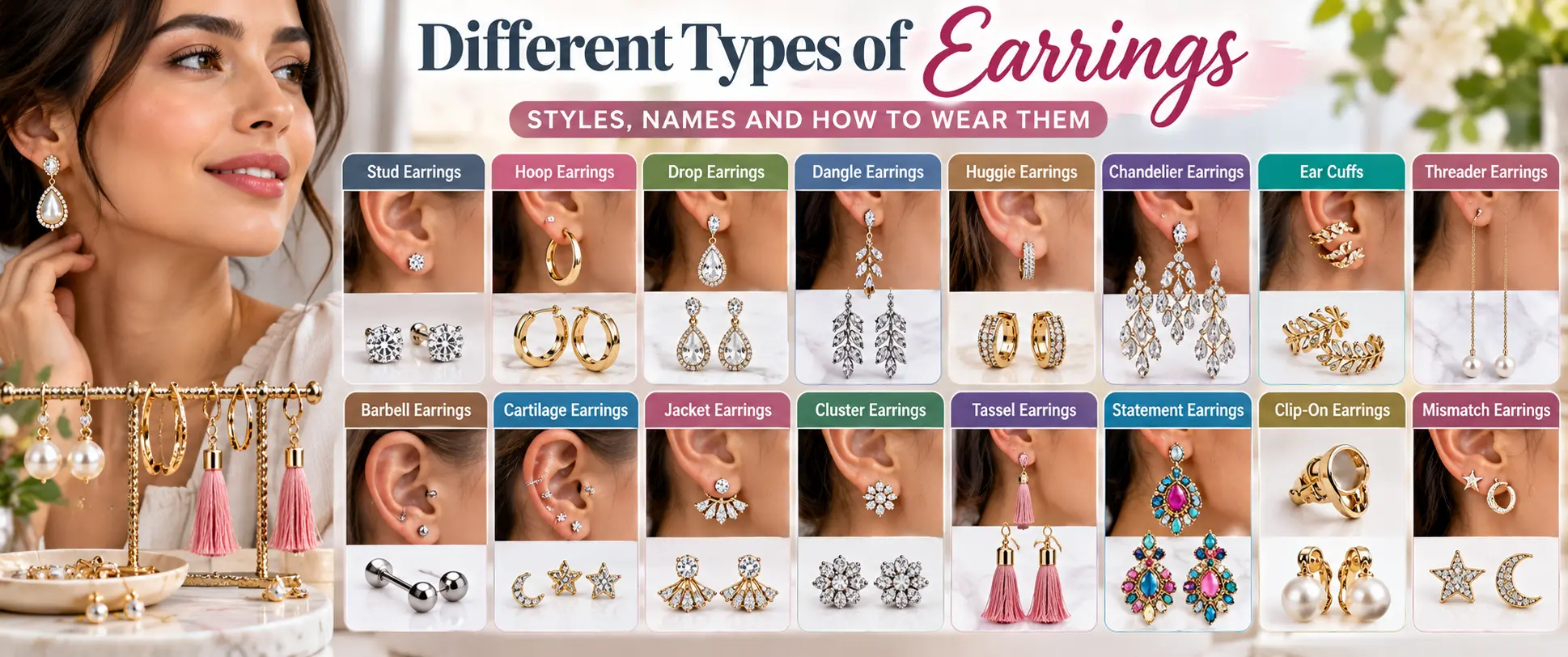
Shopping for earrings becomes much easier once you understand the different types of earrings and how each style looks when worn. Studs sit close to the ear, hoops create a circular shape, drops hang below the earlobe, while statement earrings are designed to attract more attention. Beyond appearance, however, buyers should also consider size, weight, metal, fastening style, comfort, and how often they plan to wear the earrings.
Some styles work beautifully for everyday outfits, while others suit weddings, parties, formal events, or gifts. Therefore, knowing the basic earring names can help you narrow your choices before comparing materials and prices.
This guide covers the most common styles and explains what to look for before buying.
Different Types of Earrings at a Glance
Although jewelry designers constantly create new variations, most earrings fall into a few recognizable categories.
| Earring Type | Typical Look | Often Suitable For |
|---|---|---|
| Stud | Sits directly on the earlobe | Everyday wear |
| Hoop | Circular or semi-circular | Casual to dressy outfits |
| Huggie | Small hoop close to the ear | Daily wear and stacking |
| Drop | Hangs below the earlobe | Work, dinners, events |
| Dangle | Moves freely below the ear | Parties and statement looks |
| Chandelier | Multi-level decorative design | Formal occasions |
| Threader | Fine chain threaded through piercing | Minimal modern styling |
| Ear cuff | Wraps around part of the ear | Layered jewelry looks |
| Cluster | Several stones grouped together | Dressy everyday wear |
| Jacket | Decorative element sits behind the lobe | Contemporary styling |
While these categories are useful, designs can overlap. For example, a hoop may feature dangling charms, while a stud may include a removable jacket.
Stud Earrings: Simple and Easy to Wear
Studs are among the most familiar earring styles. Typically, the decorative element sits directly on the earlobe while a post passes through the piercing and is secured from behind.
Because studs usually have a compact profile, they can be practical for work, school, casual outings, and occasions where large earrings might feel distracting.
Different Types of Stud Earrings
There are many different types of stud earrings, so shoppers are not limited to a basic round design.
Classic options include metal balls, pearls, solitaire gemstones, geometric shapes, flowers, initials, and small symbolic designs. Meanwhile, cluster studs combine several small stones or decorative elements to create a larger appearance.
Diamond studs remain popular because their simple design works with many outfits. However, buyers comparing gemstone jewelry may want to learn about the types of diamonds before deciding between different cuts, settings, and stone characteristics.
Studs also vary in fastening style. Therefore, check the backing carefully, especially when buying valuable earrings or a gift.
Different Types of Hoop Earrings
Hoops form a complete or partial circle around the ear. However, their appearance can change dramatically depending on diameter, thickness, shape, and decoration.
The different types of hoop earrings include tiny huggies, medium everyday hoops, oversized hoops, chunky hoops, oval designs, square hoops, twisted styles, and gemstone-set versions.
Huggie Earrings
Huggies are small hoops designed to sit closely around the earlobe. Since they create a neat profile, they work particularly well for minimalist outfits and multiple-piercing arrangements.
They are also easy to combine with other jewelry. For instance, someone creating a coordinated look might pair simple huggies with delicate types of bracelets rather than choosing another large statement piece.
Medium and Large Hoops
Medium hoops provide more visual presence without becoming extremely dramatic. As a result, they can transition easily from casual daytime clothing to evening outfits.
Large hoops make a stronger style statement. However, size does not always tell you how heavy an earring will feel. Hollow or lightweight designs may be easier to wear than smaller but solid pieces.
Consequently, shoppers should consider both diameter and weight before purchasing oversized hoops.
Drop and Dangle Earrings
Drop earrings extend below the earlobe, usually with a decorative piece suspended from a hook, post, or small hoop.
Some drops have limited movement. Dangle earrings, by contrast, often hang farther down and move more freely as the wearer turns their head.
Because these categories overlap, retailers may use the terms somewhat differently.
Simple gemstone drops can complement professional clothing or dinner outfits. Meanwhile, longer dangles can create more movement and visual impact for parties and special occasions.
When shopping online, check the listed length rather than judging proportions from photographs alone. Product images can make a small drop look much larger than it actually is.
Chandelier and Statement Earrings
Chandelier earrings feature branching, layered, or cascading decorative elements. Therefore, they tend to attract attention and work well when the earrings are meant to become a major part of an outfit.
Statement earrings form a broader category. They may be oversized hoops, sculptural metal designs, colorful resin pieces, elaborate gemstone earrings, or large drops.
Because these earrings can be substantial, weight deserves special attention. A dramatic design that looks beautiful in a photograph may not be comfortable for several hours.
For weddings and formal events, shoppers should also consider how the earrings interact with a necklace, hairstyle, neckline, and other accessories. Usually, one visually dominant piece is enough to create a balanced look.
Ear Cuffs, Climbers, and Jackets
Not every earring follows the traditional stud-or-hoop format.
Ear climbers, sometimes called crawlers, are designed to appear as though they travel upward along the earlobe. Therefore, they create a distinctive look without the length of traditional dangle earrings.
Ear jackets use a decorative component behind the earlobe. A small stud may appear at the front, while a larger shape extends beneath or around the lobe from behind.
Meanwhile, many ear cuffs wrap around the outer ear and some designs do not require an additional piercing. However, product construction varies, so buyers should check how a specific cuff is intended to be worn.
These styles are especially useful for shoppers who like layered or contemporary jewelry arrangements.
Threader Earrings and Chain Designs
Threader earrings use a fine chain or slender component that passes through the piercing. Part of the chain then hangs on either side of the earlobe.
As a result, they produce a delicate vertical appearance and often move gently while worn.
However, the thin construction means shoppers should examine materials and craftsmanship carefully. Pulling a delicate chain roughly through the piercing can also make the experience less comfortable.
Chain-drop earrings offer a related look, although they may use a conventional post or hook instead of threading through the piercing.
Different Types of Earrings for Men
The different types of earrings for men are largely the same fundamental styles available to any shopper. However, retailers may market particular sizes, finishes, or designs toward men’s fashion.
Common options include small studs, black or silver-tone studs, huggies, simple hoops, gemstone studs, and understated drop earrings.
Therefore, shoppers do not need to restrict themselves to a gender-specific category. Instead, focus on dimensions, material, design, and personal style.
For example, a small polished hoop creates a different effect from a large gemstone stud even if both appear in the same men’s jewelry section.
Choosing the Right Earring Material
Material affects appearance, durability, maintenance, and price. Therefore, it deserves as much attention as the earring shape.
Gold earrings are available in different purities and colors, including yellow, white, and rose gold. Meanwhile, gold-plated jewelry typically contains a base material covered with a thin layer of gold, so it should not automatically be treated as equivalent to solid gold.
When buying secondhand or higher-priced gold jewelry, knowing how to tell if gold is real can help you understand hallmarks and why professional verification may sometimes be worthwhile.
Silver is another popular choice. However, shoppers may encounter sterling silver, fine silver, silver-plated pieces, and other descriptions. Learning about the types of silver can therefore make product listings easier to compare.
Other earrings may use platinum, titanium, stainless steel, brass, or various alloys. Since individual sensitivities differ, shoppers with known metal reactions should examine the material description instead of choosing based only on color.
Gemstone Earrings: Natural and Alternative Options
Gemstones can transform even a basic stud or hoop into a more decorative piece.
Diamonds are common in studs, huggies, drops, and formal earrings. However, shoppers can also find sapphires, emeralds, rubies, birthstones, cubic zirconia, lab-grown stones, and many other choices.
Moissanite is another option frequently seen in brilliant solitaire-style jewelry. If you are comparing it with diamond, understanding what is a moissanite diamond can clarify the terminology and the fact that moissanite and diamond are different gemstones.
Rather than judging earrings by sparkle alone, check the stone description, dimensions, setting, and any grading information that applies to the product.
How to Choose Between Different Types of Earrings
The best earring style depends on when, where, and how you expect to wear it.
For everyday use, prioritize comfort and versatility. Studs, huggies, and lightweight small hoops are common choices because they tend to be less visually dominant.
For professional outfits, simple studs, modest hoops, or restrained drops can create a polished appearance. However, workplace dress expectations vary, so personal context still matters.
For evening events, larger hoops, gemstone drops, chandeliers, or sculptural statement earrings can add more visual impact.
Meanwhile, gifts require a slightly different approach. If you do not know the recipient’s exact preferences, a simple stud or small hoop may be easier to match with different wardrobes than an oversized statement design.
Earring Size and Weight Matter More Than You Think
Online shoppers often focus heavily on design while overlooking measurements.
Yet a 10 mm hoop and a 50 mm hoop create very different looks. Similarly, a tiny stud may appear much larger in a close-up product photograph.
Therefore, check diameter, drop length, width, and weight whenever the retailer provides them.
You can also compare the listed measurements with jewelry you already own. That simple step gives you a much better idea of how the earrings may look when worn.
Weight deserves equal attention, especially with chandelier and statement earrings. If you prefer lightweight jewelry, look for hollow metal, fine wire, smaller stones, or designs specifically described as lightweight.
Understanding Different Types of Earrings Names While Shopping
Knowing different types of earrings name terminology makes online searches more precise.
For example, searching only for “gold earrings” can return thousands of unrelated products. However, searching for “small gold huggie hoops” or “sterling silver threader earrings” narrows the results considerably.
Similarly, terms such as stud, hoop, huggie, drop, dangle, chandelier, climber, jacket, threader, and cuff describe the basic construction or appearance.
Once you identify the style you want, you can add material, size, gemstone, or occasion terms to refine your search.
Common Earring Buying Mistakes
One common mistake is choosing earrings entirely from enlarged product photos. Instead, always check measurements because scale can be difficult to judge online.
Another mistake is assuming every gold-colored or silver-colored product contains precious metal. Therefore, read the material description and plating information carefully.
Shoppers also sometimes ignore the closure. Push backs, screw backs, lever backs, hinged hoops, hooks, and latch mechanisms each feel different in use.
Finally, avoid assuming that a higher price automatically means the best choice. Price can vary according to material, gemstones, craftsmanship, brand, retailer, location, and time. Consequently, compare the actual specifications rather than the price tag alone.
FAQs About Earring Styles
What are the most common types of earrings?
Studs, hoops, huggies, drops, dangles, chandeliers, threaders, ear cuffs, climbers, and jackets are among the most widely recognized styles.
What earrings are easiest for everyday wear?
Many shoppers choose studs, huggies, or lightweight small hoops because their compact designs are easy to coordinate with everyday clothing. However, comfort depends on size, weight, material, and personal preference.
What is the difference between drop and dangle earrings?
Drop earrings generally extend below the earlobe, while dangle earrings often have more length and movement. However, retailers sometimes use the two terms interchangeably.
Are huggies the same as hoops?
Huggies are a type of small hoop. They usually sit much closer to the earlobe than medium or large traditional hoops.
Which earrings make a good gift?
Classic studs, small hoops, birthstone earrings, and simple gemstone designs can work well when you know the recipient’s metal preferences and style. For expensive jewelry, however, checking their preferences first can reduce the chance of choosing something they rarely wear.
Finding the Right Pair for Your Style
Once you understand the different types of earrings, shopping becomes less about choosing from an overwhelming wall of jewelry and more about matching a design to your needs.
Start with the occasion and decide whether you want subtle, versatile, or statement-making earrings. Next, compare the size, weight, material, fastening system, and gemstone details. Finally, check measurements carefully before ordering online.
A simple pair of studs may become your everyday favorite, while hoops, drops, cuffs, or chandeliers can provide a completely different look when you want a change. The best choice is the pair that fits your style, feels comfortable, and makes sense for how often you plan to wear it.