
Difference Between Sport Coat and Suit Jacket: What Should You Buy?
You spot two tailored jackets on a clothing rack. One is labeled a sport coat, while the other belongs to a two-piece suit. However, the difference between sport coat and suit jacket comes down to more than the name. Fabric, structure, matching trousers, styling flexibility, and formality all affect where you can wear each one—and which is the smarter purchase for your wardrobe.
The quick answer is simple: a suit jacket is designed as part of a matching suit, while a sport coat is designed to be worn with separate trousers. Consequently, shoppers who want maximum outfit flexibility often prefer sport coats, whereas buyers preparing for formal business settings, weddings, or other dressier occasions usually get more value from a complete suit.
Still, there are exceptions. Modern tailoring has blurred some traditional boundaries, so knowing what to check before buying can save you from an expensive wardrobe mistake.
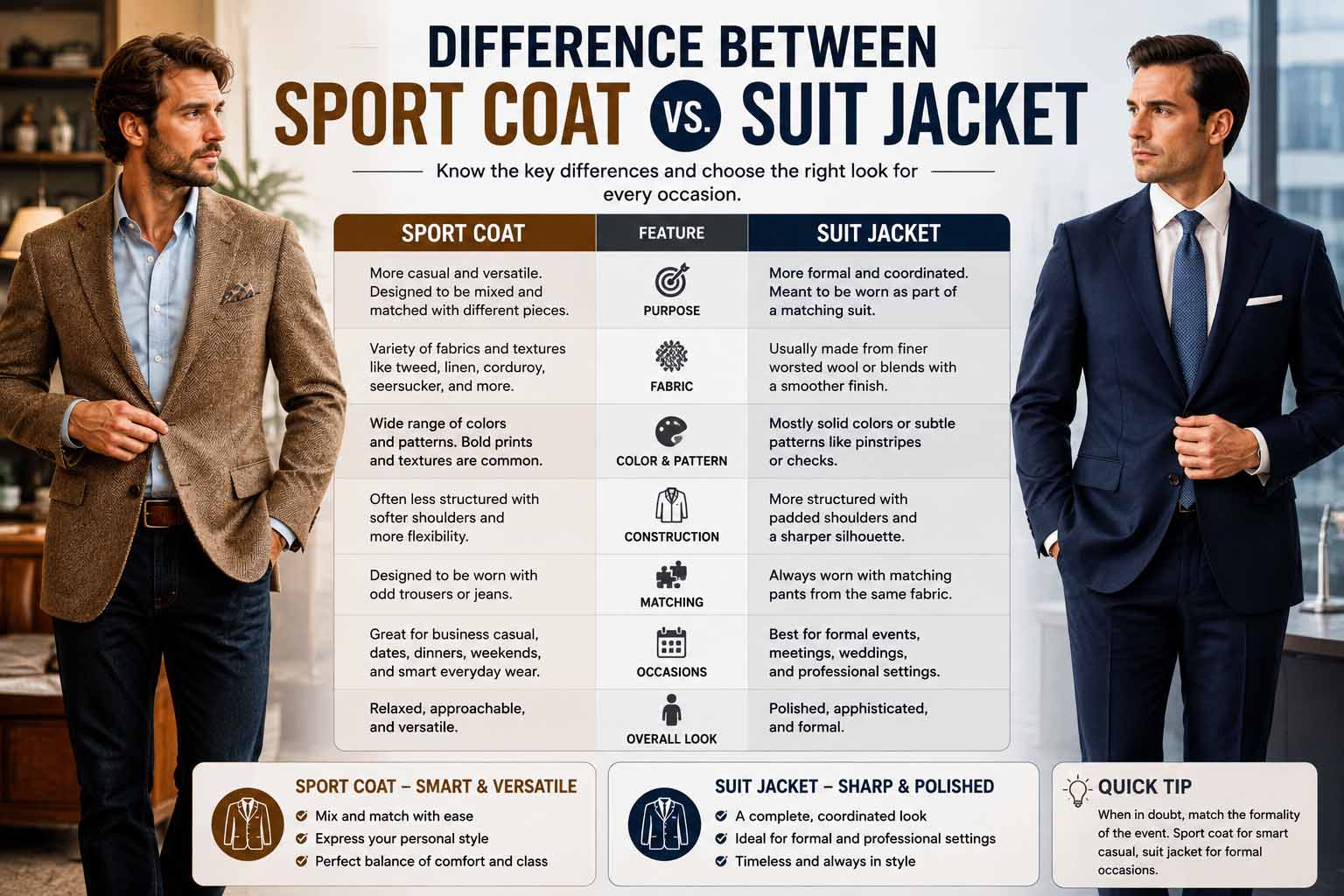
Difference Between Sport Coat and Suit Jacket at a Glance
The easiest way to compare these jackets is to look at how the manufacturer intends you to wear them.
| Feature | Sport Coat | Suit Jacket |
|---|---|---|
| Matching trousers | Not required | Designed with matching trousers |
| Typical formality | Smart casual to semi-formal | Business to formal |
| Fabric | Often textured or patterned | Usually smoother and more refined |
| Structure | Often softer | Often more structured |
| Buttons | Can be decorative or contrasting | Usually understated |
| Outfit flexibility | High | Best as part of its suit |
| Common pairings | Chinos, wool trousers, dark jeans | Matching suit trousers |
| Best buyer | Wants versatile separates | Needs a polished formal outfit |
For instance, some modern suits use soft construction, while some premium sport coats look quite formal.
Therefore, look at the entire garment instead of relying only on its label.
What Is a Sport Coat?
A sport coat is a tailored jacket designed to work independently rather than with matching trousers.
Historically, sport coats were associated with outdoor and sporting activities. Today, however, they function as versatile smart-casual clothing.
You can pair one with chinos, wool trousers, corduroys, or—in the right setting—clean dark denim. Because the trousers intentionally differ from the jacket, you can create several outfits from one purchase.
Sport coats also tend to offer more visual variety. Wool, tweed, hopsack, linen, cotton, and blends are common, while patterns may include checks, herringbone, windowpane, or subtle textures.
If you are comparing several types of coats, remember that a sport coat belongs to tailored menswear rather than the outerwear category occupied by raincoats, parkas, and overcoats.
Who Should Buy a Sport Coat?
Consider a sport coat if you want one jacket that can handle dinners, dates, business-casual offices, family events, and smart weekend outfits.
It is especially useful when a full suit would feel too formal.
For a first purchase, navy is hard to beat. It pairs easily with gray, tan, cream, and many other trouser colors. Meanwhile, subtle texture keeps the jacket from looking like an orphaned piece of a suit.
What Is a Suit Jacket?
A suit jacket is the upper half of a suit. Manufacturers cut it from the same fabric as the matching trousers and, in a three-piece suit, the waistcoat.
That matching construction is the defining feature.
Suit jackets often use smooth worsted wool or wool-blend fabrics, although linen, cotton, velvet, and other materials are available. Traditional business suits usually feature relatively restrained colors and patterns because the jacket and trousers create one continuous outfit.
Compared with many sport coats, a suit jacket may also have cleaner details, more understated buttons, and a more refined surface.
The comparison becomes slightly more complicated when blazers enter the picture. If those categories are causing confusion, understanding the difference between blazer and suit jacket helps separate another pair of garments that shoppers often mistake for each other.
Difference Between a Suit Jacket and Sport Coat Fabrics
Fabric is one of the fastest ways to identify what you are looking at.
Sport coats often embrace visible texture. Think tweed, brushed wool, hopsack, linen, or patterned cloth. Because the jacket does not need matching trousers, designers have more freedom to use bold weaves and colors.
Suit fabrics tend to look smoother.
A charcoal worsted-wool suit, for example, usually has a cleaner surface than a brown herringbone sport coat. That smoothness helps the matching jacket and trousers create a consistent, polished appearance.
However, fabric alone cannot provide a perfect answer. Casual suits made from linen or textured wool exist, while refined sport coats can use surprisingly smooth cloth.
Instead, use fabric as one clue alongside buttons, structure, pockets, pattern, and whether matching trousers are available.
Structure, Buttons, and Pocket Details
Construction also changes how each jacket feels.
Traditional suit jackets may use more internal structure through canvas, padding, and lining. This construction can create a sharper chest and shoulder line.
Meanwhile, casual sport coats often use softer shoulders and lighter construction. As a result, they can feel more relaxed even though they retain a tailored shape.
Buttons provide another clue. Suit jackets typically use buttons that blend with the fabric, whereas sport coats have more freedom to use horn-effect, metal, contrasting, or textured buttons.
Patch pockets are also common on casual sport coats. By comparison, flap or jetted pockets tend to look more formal.
These details overlap across categories, though, so avoid identifying a jacket from one feature alone.
Difference Between a Sport Coat and a Suit Jacket for Formality
This is where the buying decision becomes easier.
Choose a suit when the occasion expects matching tailored clothing. Traditional business meetings, formal weddings, interviews in conservative industries, ceremonies, and similar events may call for a complete suit.
Choose a sport coat when you want to look polished without appearing fully suited.
For example, a navy sport coat with gray wool trousers and a button-down shirt works well for many business-casual settings. Remove the tie, and the same jacket can transition easily into an evening outfit.
Formalwear sits another step above many suits. Therefore, shoppers preparing for black-tie events should understand the difference between tux and suit rather than assuming any dark suit jacket can replace a tuxedo.
Can You Wear a Suit Jacket as a Sport Coat?
Sometimes—but this is where many shoppers make a styling mistake.
A suit jacket can work as a separate if it already looks relatively casual. Softer construction, textured fabric, patch pockets, and a versatile color all make separation easier.
However, a smooth pinstripe business-suit jacket usually looks incomplete when paired with chinos or jeans. The jacket may appear as though its matching trousers have simply gone missing.
There is another practical concern: uneven wear.
If you frequently wear the suit jacket separately but save the trousers for formal occasions, the jacket may fade or wear faster. Eventually, the two pieces can stop looking perfectly matched.
Therefore, if you plan to wear a tailored jacket regularly with several trousers, buying a dedicated sport coat is usually safer.
Sport Coat vs Blazer: Don’t Confuse Them
Shoppers also use “sport coat” and “blazer” interchangeably, although traditional menswear distinguishes them.
A blazer is a standalone tailored jacket like a sport coat, but classic blazers usually have a cleaner, more uniform appearance. Navy is strongly associated with the style, and metal buttons are a traditional feature.
Sport coats generally offer more texture and pattern variety.
Modern retailers do not always follow those definitions strictly. Consequently, checking the fabric, construction, styling, and intended use matters more than trusting the product name alone.
For a closer comparison, the difference between sport coat and blazer comes down largely to these traditional styling details rather than the matching-trouser distinction that separates both from a suit jacket.
How Should a Sport Coat or Suit Jacket Fit?
Whether you spend a little or a lot, poor fit can make an otherwise good jacket look wrong.
Start with the shoulders. The shoulder seam should generally finish near the natural end of your shoulder without obvious overhang or severe pulling.
Next, button the jacket.
A properly fitted jacket should close without creating strong X-shaped pulling across the front. At the same time, excess fabric should not hang loosely around your torso.
Sleeve length matters too. Many wearers prefer enough jacket sleeve length to leave a small amount of shirt cuff visible, although exact preferences vary.
The collar should sit cleanly around your neck rather than creating a large gap.
Finally, check jacket length and overall proportions. Trends change, but extreme cuts tend to date more quickly. If you want an evergreen purchase, a balanced traditional length is generally more versatile.
Which Material Should You Buy?
For an all-purpose jacket, wool is one of the safest options.
Wool regulates temperature well, drapes cleanly, resists wrinkles better than many fabrics, and works across a broad range of occasions. Lightweight wool can also remain comfortable in warmer weather.
Linen offers excellent warm-weather character, although it wrinkles easily. Instead of treating those wrinkles as defects, many shoppers accept them as part of linen’s relaxed appearance.
Cotton sport coats tend to feel casual and approachable. Meanwhile, synthetic fibers such as polyester can reduce cost and sometimes improve wrinkle resistance, although fabric quality and breathability vary.
Blended materials can provide a practical middle ground.
When comparing types of clothing, fabric labels are worth checking because two garments with almost identical photos can feel and perform very differently once worn.
What Should You Expect to Pay?
Prices vary enormously based on brand, fabric, construction, country of manufacture, retailer, alterations, and sales.
Entry-level sport coats and suits often use fused construction and synthetic blends to control cost. Mid-range garments may offer better wool, cleaner construction, and more refined details.
At higher price points, buyers may encounter full-canvas or half-canvas construction, premium natural fabrics, hand-finished details, and more complex tailoring.
However, price alone does not guarantee a better purchase.
A moderately priced jacket that fits your shoulders well and needs only minor tailoring can look better than an expensive jacket with poor proportions.
Therefore, include alteration costs in your budget. Sleeve length, waist suppression, and trouser hemming are common adjustments, although some alterations are easier and cheaper than others.
Common Shopping Mistakes to Avoid
One common mistake is buying a suit jacket with plans to use it constantly as a sport coat. Unless the design works well as a separate, you may end up with a jacket that never looks quite right with casual trousers.
Another mistake is focusing on size labels instead of fit. A size 40 from one brand may fit differently from a size 40 elsewhere. Whenever possible, try the jacket on or carefully compare your measurements with the retailer’s size chart.
Avoid buying based only on trendy details, too. Extremely short jackets, oversized lapels, tiny lapels, or unusually tight cuts can limit long-term versatility.
Finally, do not ignore your existing wardrobe. A beautiful brown checked sport coat offers limited value if none of your trousers, shirts, or shoes work with it.
FAQs About the Difference Between Sport Coat and Suit Jacket
Is a sport coat more casual than a suit jacket?
Generally, yes. Sport coats are designed as separates and often use more casual fabrics, patterns, buttons, and construction. Suit jackets usually look more formal because they belong to matching trousers.
Can you wear a sport coat to a wedding?
Often, yes, if the dress code allows smart-casual, cocktail, or semi-formal separates. However, a formal dress code may call for a suit or tuxedo instead. When in doubt, follow the couple’s stated dress code.
Can you wear jeans with a sport coat?
Yes, provided the event is casual enough. Dark, clean jeans with minimal distressing usually work better than heavily faded or ripped denim. A textured sport coat also tends to pair with denim more naturally than a highly formal jacket.
Should your first tailored jacket be a suit or sport coat?
Buy a suit first if you regularly attend formal events, interviews, weddings, or conservative business meetings. However, choose a sport coat first if your daily life is mostly smart casual and you want maximum outfit variety.
Can suit jackets and sport coats use the same size?
Often they can, but sizing varies between brands, cuts, and models. Therefore, treat the label as a starting point and judge the shoulders, chest, waist, sleeves, and length on your body.
Which One Belongs in Your Wardrobe?
The difference between sport coat and suit jacket is easiest to remember this way: a suit jacket belongs to matching trousers, while a sport coat is intentionally designed to stand on its own.
If you need clothing for interviews, formal business settings, ceremonies, or dressier weddings, buy a complete suit and keep the pieces together whenever possible. On the other hand, if you want a versatile jacket for restaurants, work, dates, travel, and smart-casual events, a sport coat will usually give you more outfit combinations.
For many shoppers, a navy or medium-textured wool sport coat makes an excellent first separate. Meanwhile, a navy or charcoal wool suit remains one of the most practical choices for formal needs.
Whichever route you choose, prioritize fit before labels, trends, or small design details. A jacket that fits properly, works with your existing wardrobe, and suits the places you actually go will earn far more wear than one purchased simply because it looked impressive on the rack.