

What Is Engineered Wood? A Practical Buyer’s Guide
If you are shopping for flooring, furniture, cabinets, or home materials, you may wonder what is engineered wood and whether it is a good alternative to solid timber. In simple terms, manufacturers create engineered wood by combining wood fibers, veneers, strands, or particles with adhesives and pressure. Depending on the product, it can offer good strength, consistent sizing, lower cost, and better resistance to warping than some types of solid wood.
What Is Engineered Wood?
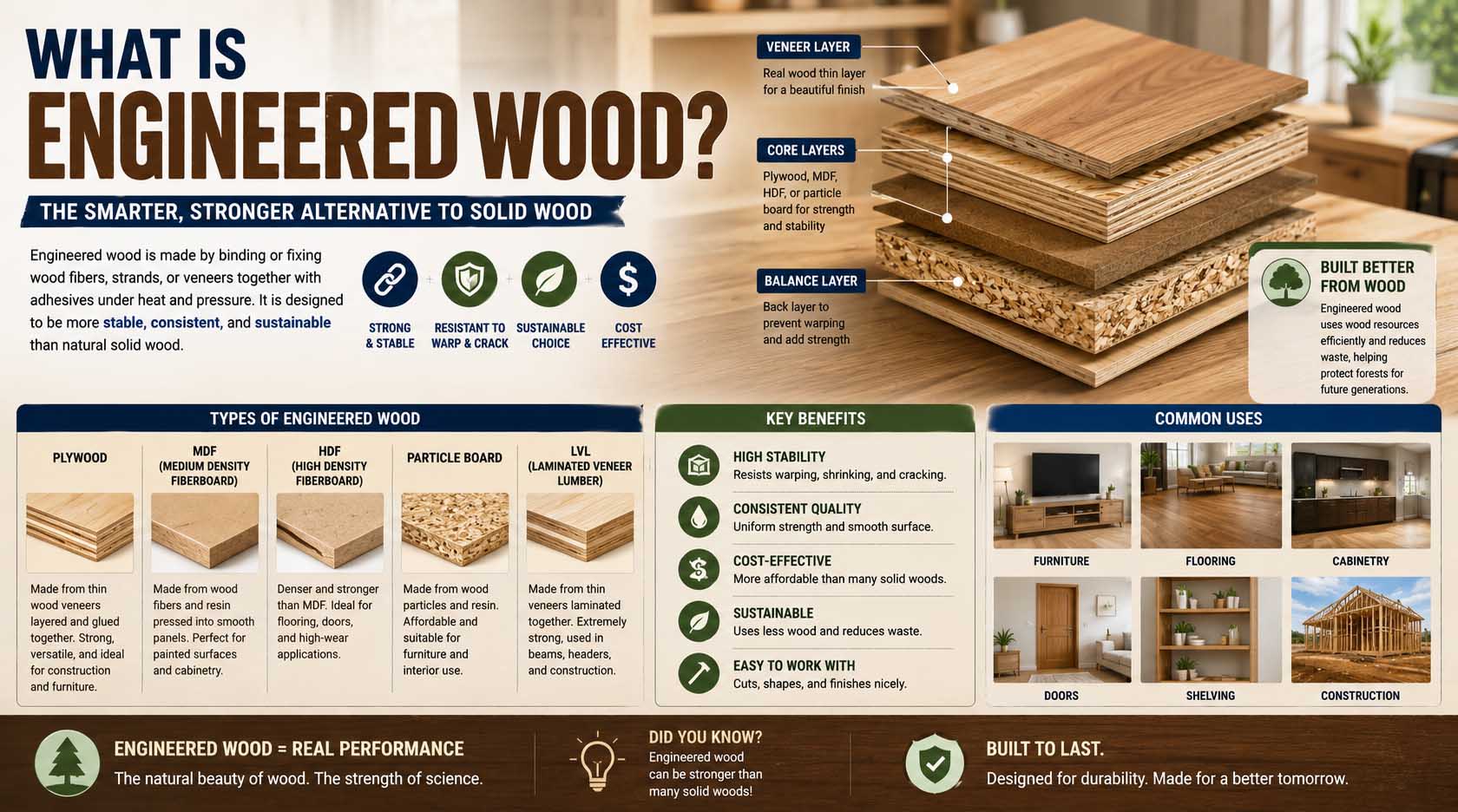
Engineered wood is a broad category of wood-based products that manufacturers create instead of cutting directly from a single solid piece of timber. They take real wood components such as thin veneers, fibers, strands, or chips and bond them together with adhesives, heat, and pressure.
As a result, manufacturers can design the final material for specific uses. For example, plywood consists of layers of thin wood veneer, while MDF uses fine wood fibers. Particleboard relies on larger wood particles, and engineered flooring usually combines a real hardwood surface layer with a layered core.
So, what is engineered wood? It is still a wood-based material, but manufacturers modify its structure to improve consistency, usability, and cost efficiency.
This versatility makes it common in modern homes, including cabinets, shelving, flooring, wall panels, doors, and furniture.
How Manufacturers Make Engineered Wood
The exact manufacturing process depends on the product, but most engineered wood begins with wood that manufacturers process into smaller components.
Manufacturers may use:
- Thin wood veneers
- Wood fibers
- Wood strands
- Wood chips
- Sawdust
- Recycled wood material
They then arrange or compress these components with resin or adhesive. After that, heat and pressure form boards, sheets, or planks with predictable thickness and strength.
Because manufacturers control the structure, they can often produce engineered materials in larger, flatter sheets than natural lumber. Therefore, these products work well for cabinets, wardrobes, shelving, and flooring systems.
Common Types of Engineered Wood
Not all engineered wood performs the same way. Therefore, knowing the main types helps you avoid buying the wrong material for your project.
Plywood
Manufacturers create plywood by bonding thin sheets of wood veneer together. Usually, they alternate the grain direction between layers, which improves dimensional stability.
Because of this construction, builders and furniture makers commonly use plywood for furniture, cabinets, subfloors, wall sheathing, and structural projects.
Higher-grade plywood can look attractive enough for visible furniture, while construction-grade products work better for hidden structural applications.
MDF
Manufacturers make medium-density fiberboard, or MDF, by compressing fine wood fibers with resin.
MDF has a very smooth surface, so manufacturers often use it for painted furniture, cabinet doors, trim, and decorative panels. However, standard MDF can swell badly when it encounters moisture.
For that reason, buyers should check whether they need a moisture-resistant grade before using MDF in bathrooms, kitchens, or other damp areas.
Particleboard
Particleboard is usually one of the more affordable engineered wood products. Manufacturers create it by bonding wood particles with resin.
Furniture makers commonly use it in budget furniture, shelving, and flat-pack cabinets. However, particleboard generally holds screws less securely than quality plywood and can suffer significant damage when water reaches the core.
Therefore, it makes the most sense for dry indoor areas and low- to moderate-stress applications.
OSB
Manufacturers create oriented strand board from long wood strands arranged in specific directions and bonded together.
Builders often use OSB for roof decking, wall sheathing, and subfloors. Although it may not offer the decorative appearance of plywood, it can provide good structural performance when builders use it correctly.
What Is Engineered Wood Flooring?
Many shoppers specifically ask what is engineered wood flooring because it looks similar to hardwood but has a different construction.
Engineered flooring usually has a thin layer of real hardwood on top. Beneath that surface, manufacturers add multiple layers of plywood or another stable wood-based core for strength.
Because of its layered design, engineered flooring tends to react less dramatically to humidity changes than solid hardwood. Therefore, it can sometimes work better in areas where moisture or temperature changes are a concern.
If you are comparing flooring materials, understanding what is lvp flooring can also help because luxury vinyl plank is another popular wood-look option, although manufacturers make it from synthetic materials rather than real wood layers.
Engineered Wood vs Solid Hardwood Flooring
Solid hardwood consists of one piece of timber from top to bottom. In contrast, engineered flooring uses a hardwood wear layer over a manufactured core.
Solid wood often allows more refinishing over its lifetime because the material remains thick throughout. However, engineered flooring can offer better dimensional stability.
The better choice depends on the installation area, your budget, the thickness of the wear layer, and how long you expect to keep the flooring.
What Is Engineered Wood Furniture?
Another common question is what is engineered wood furniture. In most cases, this term refers to furniture that manufacturers make with MDF, plywood, particleboard, or similar wood-based products rather than solid timber.
Engineered wood furniture can be a smart purchase when you want attractive designs at a lower price. For example, manufacturers commonly use these materials for wardrobes, desks, bookcases, TV stands, and kitchen cabinets.
However, quality varies greatly. A well-made plywood cabinet can be strong and durable, while a thin particleboard shelf may sag under heavy loads.
Therefore, shoppers should look beyond the general label “engineered wood” and check exactly which material the product contains.
Engineered Wood vs Solid Wood
Both materials have advantages, so one is not automatically better in every situation.
| Feature | Engineered Wood | Solid Wood |
|---|---|---|
| Cost | Often lower | Usually higher |
| Stability | Often more consistent | Can expand or shrink more |
| Appearance | Varies by type and finish | Natural grain throughout |
| Repairability | Depends on material | Often easier to sand or refinish |
| Moisture resistance | Varies widely | Depends on species and finish |
| Weight | Often lighter | Usually heavier |
| Durability | Highly product-dependent | Can last for decades |
People often prefer solid wood for heirloom furniture and pieces they may refinish many times. However, engineered wood can provide excellent value for cabinets, shelving, flooring, and everyday furniture.
Advantages of Engineered Wood
Engineered wood has become popular because it offers several practical benefits.
First, manufacturers can make efficient use of wood resources because they can use smaller pieces, fibers, and veneers.
Second, the material is usually more uniform than natural lumber. Therefore, boards may remain flatter and prove easier to work with.
Third, many engineered products cost less than comparable solid hardwood.
Finally, some types offer greater dimensional stability, so they are less likely to shrink, expand, or warp under normal indoor conditions.
These advantages help explain why builders widely use engineered materials in modern construction. For example, homes discussed in guides about what is a modular home often rely heavily on manufactured building products because consistent dimensions can simplify factory-based construction.
Disadvantages to Consider Before Buying
Engineered wood also has limitations.
Lower-grade particleboard can chip easily and may not hold fasteners well after repeated assembly. Meanwhile, standard MDF can absorb water quickly and swell.
Some products also become difficult to repair after serious damage reaches the outer surface.
Engineered flooring has another limitation: the thickness of the hardwood wear layer affects whether owners can sand and refinish the floor and how often they can do so.
Therefore, buyers should not assume every engineered product offers the same lifespan.
Is Engineered Wood Waterproof?
Some products resist moisture better than others. However, prolonged water exposure can damage cores, adhesives, edges, or finishes.
This distinction matters especially for flooring. If you are asking what is the best waterproof engineered wood flooring, be cautious with marketing language. Manufacturers may describe many products as water-resistant rather than truly waterproof.
For kitchens, basements, mudrooms, or bathrooms, check the manufacturer’s moisture rating, installation instructions, warranty exclusions, and approved locations before buying.
In some wet-prone areas, vinyl or tile may offer a more practical option.
Where Engineered Wood Works Best
Engineered wood can be a good choice for many indoor projects.
People commonly use it for:
- Kitchen cabinets
- Wardrobes
- Bookshelves
- Desks
- TV units
- Interior doors
- Wall panels
- Flooring
- Subfloors
- Decorative trim
It also appears in different architectural styles. For example, a guide explaining what is a barndominium may mention engineered flooring, cabinetry, or structural panels because these materials can offer practical cost and installation advantages in modern residential interiors.
Similarly, manufacturers can make wall finishes such as what is shiplap from MDF or other engineered products rather than traditional solid timber, especially when the goal is a smooth painted finish.
How to Judge Quality Before Buying
The words “engineered wood” alone do not tell you whether a product offers high quality.
Instead, check the actual material specification.
Look at the Core Material
Plywood generally performs better than low-density particleboard for demanding furniture applications. However, good-quality MDF can work very well for painted doors and decorative surfaces.
Therefore, match the core to the intended use.
Check Thickness
Thin boards may flex or sag under weight. Consequently, shelves, desks, and cabinet sides should have enough thickness for their expected load.
Inspect Edges and Joints
Exposed particleboard edges can absorb moisture more easily. Good edge banding, sealed surfaces, and clean joinery often indicate better construction.
Review Hardware
Strong hinges, drawer runners, brackets, and fasteners can significantly affect how long furniture lasts.
Even good engineered wood can perform poorly when manufacturers use weak hardware.
Ask About Moisture Resistance
If you plan to use the product near sinks, laundry areas, kitchens, or bathrooms, confirm whether the manufacturer rates the board for damp conditions.
Do not rely only on a glossy finish because the inner core can still remain vulnerable.
Price: Is Engineered Wood Cheaper?
Often, yes. However, prices vary widely.
Basic particleboard furniture can be inexpensive, while premium plywood cabinetry or high-quality engineered hardwood flooring can cost significantly more.
Meanwhile, factors such as veneer species, thickness, finish, brand, installation, hardware, and retailer markup all influence the final price.
Therefore, compare products based on construction quality rather than simply choosing the cheapest option.
A slightly higher upfront cost may make sense when the material has a stronger core, thicker wear layer, better hardware, or longer warranty.
Maintenance Tips
Most engineered wood products are easy to maintain with proper care.
For furniture, wipe spills promptly and avoid soaking the surface. Meanwhile, use a soft damp cloth rather than excessive water.
For flooring, follow the manufacturer’s cleaning recommendations because strong chemicals or steam cleaners may damage some finishes.
Also, protect furniture from standing water and extreme humidity.
If a surface becomes scratched, repair options depend on the finish. Owners may perform minor touch-ups on some veneered furniture, while deep damage to particleboard or MDF can prove harder to repair cleanly.
Common Buying Mistakes
One common mistake is assuming all engineered wood is cheap or low quality. In reality, premium plywood and high-grade engineered flooring can perform extremely well.
Another mistake is ignoring the core material. A product labeled simply as engineered wood may contain plywood, MDF, particleboard, or a combination.
Shoppers also sometimes choose furniture based only on appearance. However, thickness, joints, edge sealing, and hardware matter just as much.
Finally, do not assume “water-resistant” means “waterproof.” Always read the manufacturer’s specifications before buying products for moisture-prone areas.
FAQs About Engineered Wood
Is Engineered Wood Real Wood?
Yes. Engineered wood contains real wood material. However, manufacturers process and bond that material into a manufactured product rather than leaving it as a single solid piece of timber.
Is Engineered Wood Better Than MDF?
Engineered wood is a broad category, and MDF is one type of engineered wood. Therefore, the comparison depends on what other material you are considering, such as plywood or particleboard.
Is Engineered Wood Good for Furniture?
Yes, it can be. Furniture and cabinet manufacturers widely use quality plywood and MDF. However, durability depends on board quality, thickness, hardware, and construction.
How Long Does Engineered Wood Furniture Last?
There is no fixed lifespan. High-quality products can last many years, while low-cost particleboard furniture may wear out much sooner, especially after moisture exposure or frequent moving.
Can Engineered Wood Be Refinished?
Some products can. For example, owners may sand and refinish engineered hardwood flooring when it has a sufficiently thick wear layer. However, thin veneers and laminate-covered boards usually do not allow the same refinishing options as solid wood.
Is Engineered Wood Safe for Indoor Use?
Indoor air quality can be an important consideration with composite wood products because some adhesives can release formaldehyde. In the United States, the EPA’s formaldehyde emission standards for composite wood products establish requirements for products such as hardwood plywood, MDF, and particleboard.
Therefore, shoppers who care about indoor air quality can check product labels, low-emission certifications, and manufacturer testing information before buying.
A Smarter Way to Buy Engineered Wood Products
When you understand what is engineered wood, shopping becomes much easier because you can judge the actual construction instead of relying on a broad label.
Start by identifying the specific type of board. Then, check thickness, moisture resistance, hardware, finish quality, and warranty. Meanwhile, for flooring, pay special attention to the wear layer and installation requirements.
Engineered wood can provide excellent value when you match it to the right use. However, the best purchase is not always the cheapest one. Instead, choose the material based on where you will use it, how much wear it will receive, and how long you want it to last.