
How to Tell if a Diamond Is Real: Simple Tests, Buying Tips, and Expert Advice
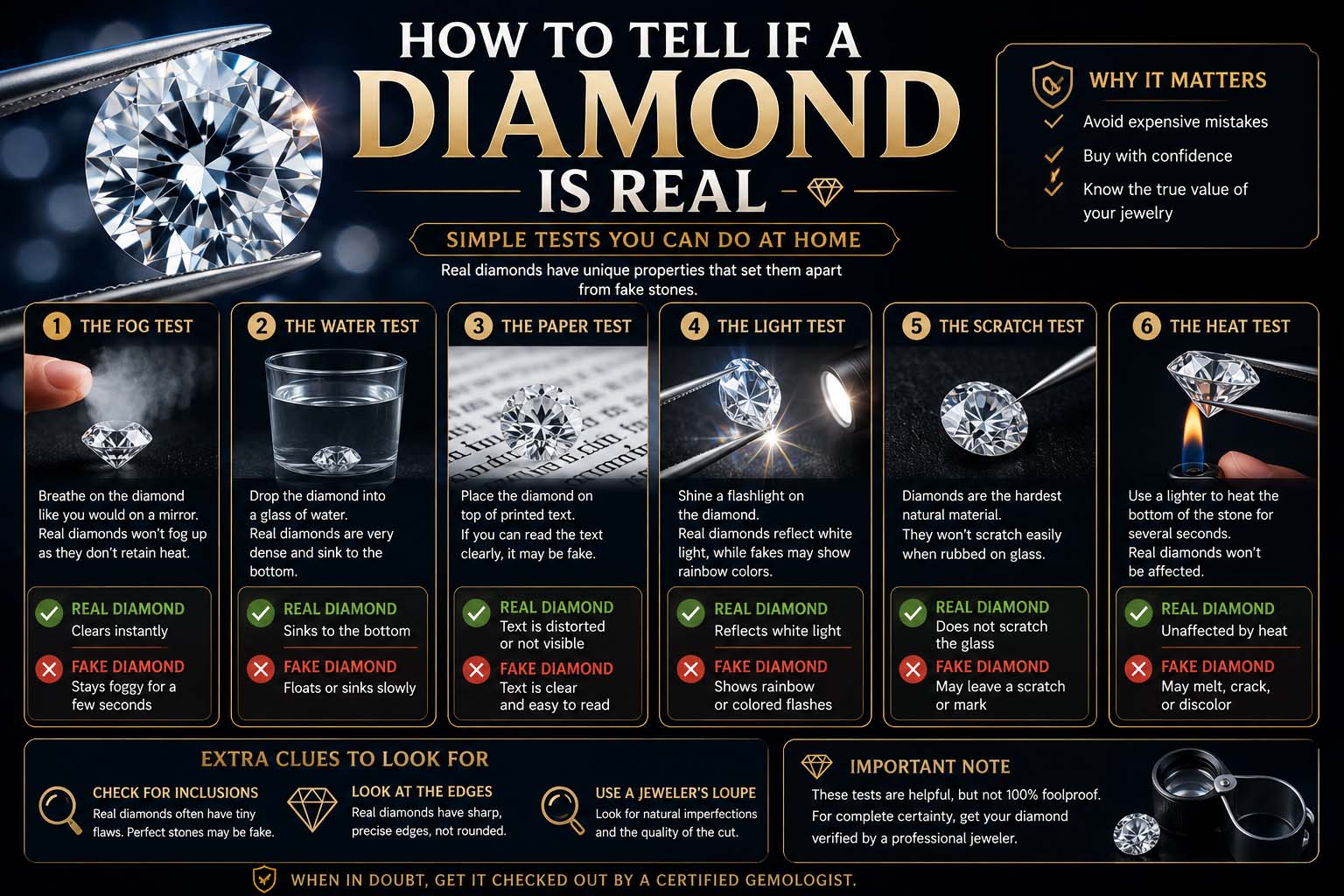
To learn how to tell if a diamond is real, you can check its sparkle, reflection, and clarity. A genuine diamond usually reflects bright white light and has natural imperfections. However, simple home tests are not always reliable, so the best way to confirm a diamond is real is to have it examined by a professional jeweler or gemologist.
The good news is that you don’t always need expensive equipment to make an initial assessment. While several simple checks can help you identify obvious fakes, professional testing offers complete confidence before making a purchase.
This guide explains how to tell if a diamond is real, which home tests actually work, and what buyers should know before spending their money.
Quick Signs of a Real Diamond
Before trying any tests, here’s a quick overview.
| Feature | Real Diamond | Common Fake |
|---|---|---|
| Sparkle | Bright white and colorful flashes | Often too colorful or dull |
| Hardness | Extremely hard | Easier to scratch |
| Fog Test | Clears almost instantly | Fog lingers longer |
| Heat Resistance | Excellent | Varies by material |
| Professional Certificate | Usually available | Often missing |
However, remember that no single home test is perfect. Therefore, combining several methods gives you a much better idea before visiting a jeweler.
Why It Can Be Difficult to Identify a Real Diamond
Modern diamond simulants have improved dramatically.
Common alternatives include:
- Cubic zirconia
- Moissanite
- White sapphire
- Glass
- Synthetic diamonds
In fact, some look remarkably similar to natural diamonds, especially to the untrained eye.
That’s why professional verification is recommended for expensive purchases. In addition, shoppers comparing gemstones may explore the different types of diamonds or ask what is a moissanite diamond.
How to Tell if a Diamond Is Real at Home
If you’re wondering how to tell if a diamond is real at home, start with safe, non-destructive tests.
When performed carefully, these methods won’t damage the stone.
The Fog Test
One of the simplest methods is the fog test.
How to Do It
- Breathe on it like you’re fogging a mirror.
- Watch how quickly the fog disappears.
Results
A real diamond disperses heat very efficiently.
As a result, the fog usually disappears within one or two seconds.
If condensation stays longer, the stone may not be a diamond.
However, keep in mind that environmental conditions can affect the results.
How to Tell if a Diamond Is Real with a Flashlight
Many buyers search for how to tell if a diamond is real with a flashlight because it’s one of the easiest tests you can perform at home. While a flashlight cannot provide absolute proof that a diamond is genuine, it can reveal clues about how the stone interacts with light.
What You’ll Need
- LED flashlight
- Dark room
- Clean diamond
Shine the flashlight through the stone from different angles.
A genuine diamond reflects light in complex patterns with bright white sparkle and smaller rainbow flashes.
In contrast, very large rainbow reflections often indicate cubic zirconia rather than a natural diamond.
Therefore, this test works best when combined with others.
The Water Test for a Diamond
This popular method is quick and safe.
Steps
- Fill a clear glass with water.
- Carefully drop the loose diamond into the glass.
Because a real diamond has high density, it usually sinks immediately.
However, many fake stones also sink, so this shouldn’t be your only test.
Additionally, mounted diamonds cannot be tested this way.
How to Tell if a Diamond Is Real with a Mirror
Some people ask how to tell if a diamond is real with a mirror.
This method is similar to the fog test.
First, place the clean diamond near a mirror and breathe on both surfaces.
The mirror stays fogged longer because glass retains heat differently.
In contrast, a real diamond usually clears much faster.
Again, this provides only a rough indication rather than proof.
Examine the Diamond Under Magnification
A jeweler’s loupe is inexpensive and useful.
Look for:
- Tiny natural inclusions
- Sharp facet edges
- High-quality polishing
- Small imperfections
Many fake diamonds appear almost too perfect.
Meanwhile, natural diamonds often contain microscopic internal features formed over millions of years.
Lab-grown diamonds may also contain unique growth characteristics, making professional evaluation helpful.
Check the Diamond Setting
If you’re trying to learn how to tell if a diamond ring is real, don’t ignore the ring itself.
Quality diamonds are usually mounted in precious metals.
Look for stamps such as:
- 10K
- 14K
- 18K
- PT
- Platinum
- 950
A valuable diamond is less likely to be set in inexpensive plated metal.
Although this isn’t a guarantee, it provides another useful clue. Likewise, jewelry buyers may want to learn how to tell if gold is real or how to tell if silver is real.
Diamond Sparkle and Light Performance
Real diamonds create a unique combination of:
- White brilliance
- Rainbow fire
- Sharp reflections
In contrast, many fake stones produce overly colorful flashes that can look artificial.
If possible, compare your stone with a certified diamond.
In fact, side-by-side comparisons often reveal noticeable differences.
Scratch Test: Should You Try It?
Years ago, people recommended scratching glass.
However, today, most experts advise against it.
Reasons include:
- Risk of damaging jewelry
- Possible damage to glass
- Not all simulants scratch easily
- Modern testing methods are much safer and more reliable
Professional Diamond Testing
Home methods provide useful clues, but they cannot confirm authenticity with complete certainty.
Professional jewelers use specialized tools such as:
- Diamond testers
- Thermal conductivity testers
- Electrical conductivity testers
- Microscopes
- Gemological analysis
As a result, these tests quickly distinguish diamonds from most simulants. For additional guidance, buyers may also learn how to tell if diamonds are real.
Natural Diamonds vs Lab-Grown Diamonds
Many shoppers wonder whether lab-grown diamonds are “real.”
The answer is yes.
Lab-grown diamonds have:
- The same chemical composition
- The same hardness
- The same sparkle
- The same crystal structure
The main difference is their origin.
While natural diamonds form underground over millions of years, lab-grown diamonds are created differently.
Therefore, professional laboratories can identify the difference.
Common Diamond Simulants
Understanding common alternatives makes shopping easier.
| Stone | Looks Like Diamond | Real Diamond |
|---|---|---|
| Cubic Zirconia | Very similar | No |
| Moissanite | Extremely similar | No |
| White Sapphire | Somewhat similar | No |
| Glass | Basic imitation | No |
| Lab-Grown Diamond | Yes | Yes |
Overall, each material has its own strengths, appearance, and price.
Buying Guide: How to Shop for a Real Diamond
Whether buying online or in-store, follow these tips.
Ask for Certification
Look for grading reports from respected laboratories.
Certificates verify:
- Carat weight
- Color
- Clarity
- Cut
- Measurements
Buy From Reputable Sellers
Choose retailers with:
- Positive customer reviews
- Clear return policies
- Authenticity guarantees
- Transparent pricing
Generally, established jewelers provide better customer support.
Compare Prices Carefully
A deal that seems too good to be true often deserves extra attention.
Large price differences may indicate:
- Lower quality
- Synthetic stones
- Simulants
- Missing certification
Therefore, take time to compare similar diamonds before making a decision.
Diamond Care Tips
Protect your investment with proper care.
- Clean jewelry regularly using mild soap and warm water.
- Store pieces separately to prevent scratches.
- Remove rings before heavy work.
- Have settings inspected once a year.
- Avoid harsh household chemicals.
Ultimately, proper maintenance keeps diamonds looking brilliant for years.
Common Diamond-Shopping Mistakes
Many buyers make avoidable mistakes.
Try not to:
- Buy without certification.
- Focus only on carat size.
- Ignore cut quality.
- Skip return policies.
- Trust only one home test.
- Purchase from unknown sellers without research.
A little extra research can prevent costly problems.
Should You Buy a Diamond Online?
Buying online has become increasingly popular.
Advantages include:
- Larger selection
- Competitive pricing
- Detailed grading reports
- High-resolution photos
- Convenient comparison shopping
Before ordering, verify:
- Return policy
- Certification
- Warranty
- Customer reviews
- Secure payment options
Many reputable online jewelers provide excellent buying experiences.
Quick Diamond-Buying Checklist
Before purchasing, confirm these points:
- ✔ Certified grading report
- ✔ Trusted retailer
- ✔ Clear return policy
- ✔ High-quality photos
- ✔ Metal stamp verified
- ✔ Fair market pricing
- ✔ Warranty available
- ✔ Independent appraisal if needed
Overall, this simple checklist helps reduce buying risks.
Frequently Asked Questions
How can I tell if a diamond is real at home?
Safe methods include the fog test, flashlight test, magnification, water test for loose stones, and checking the jewelry setting. However, none of these alone provide absolute proof.
How to tell if a diamond is real with a flashlight?
Shine an LED flashlight through a clean diamond in a dark room. Genuine diamonds display bright white brilliance with balanced rainbow flashes rather than excessive colorful reflections.
How Can You Verify a Diamond Ring’s Authenticity?
Inspect the metal stamp, examine the stone under magnification, perform simple home tests, and request a grading certificate from the seller.
How to tell if a diamond is real with a mirror?
Breathe on the stone and compare how quickly the condensation disappears. Real diamonds usually clear much faster because they disperse heat efficiently.
Are lab-grown diamonds real?
Yes. Lab-grown diamonds are real diamonds. They have the same physical, chemical, and optical properties as natural diamonds, making them identical in beauty, brilliance, and durability.
Can a jeweler confirm whether a diamond is real?
Yes. Professional jewelers use specialized equipment that accurately identifies diamonds and distinguishes them from most simulants.
Smart Shopping Starts with Good Information
Learning how to tell if a diamond is real helps you shop with greater confidence, whether you’re buying an engagement ring, upgrading your jewelry collection, or evaluating a family heirloom. Simple home tests can provide useful clues, but they should never replace professional verification for valuable purchases.
The safest approach is to combine careful visual inspection, trusted certification, and a reputable jeweler. Ultimately, taking a little extra time before buying can help you avoid costly mistakes and ensure that your diamond is exactly what you expect.