

What Is a Cesspool? A Practical Guide for Homeowners and Buyers
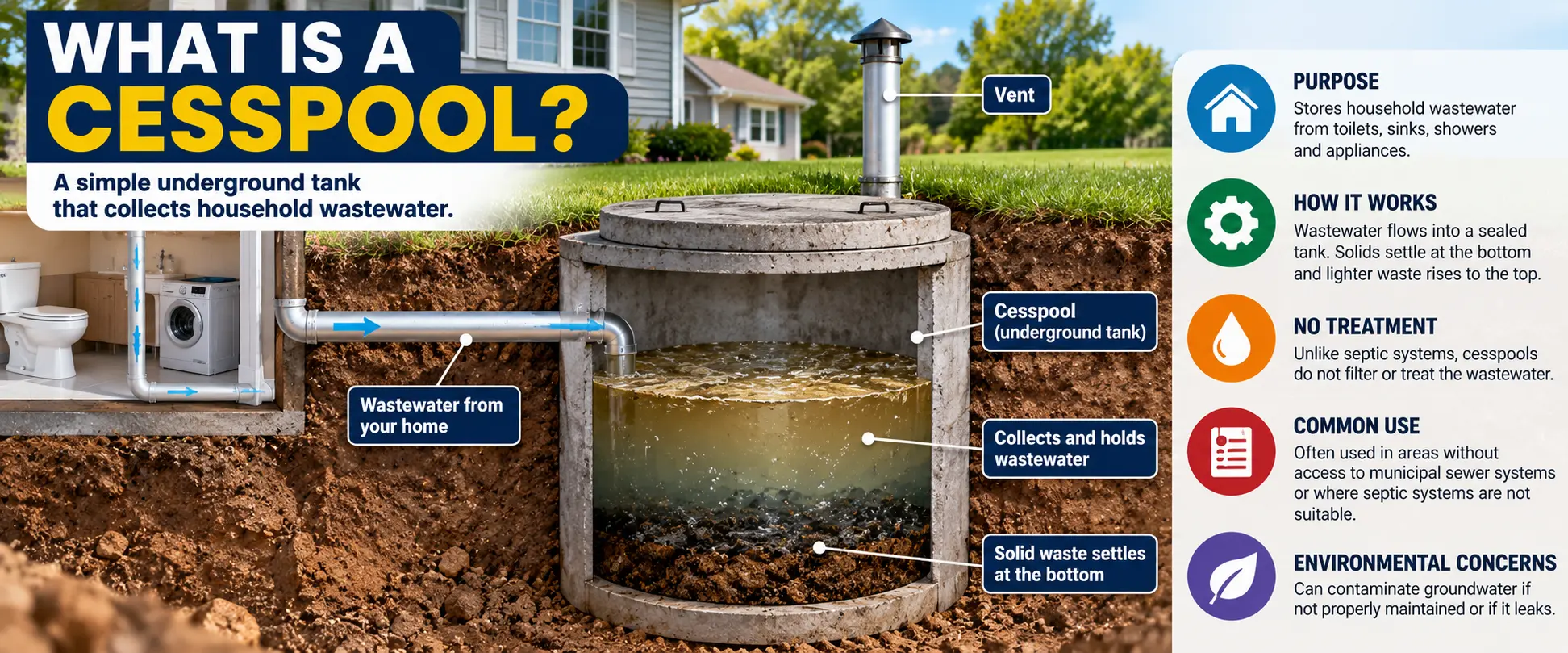
If you are shopping for an older home or researching its wastewater system, you may ask, what is a cesspool and how does it affect the property? A cesspool is an underground chamber or pit that receives household wastewater and allows liquid waste to move into the surrounding soil while solids remain inside. Unlike a modern septic system, a traditional cesspool generally does not use a separate septic tank and engineered drain field to treat and disperse wastewater.
For homeowners, that difference matters. A property’s wastewater system can affect maintenance needs, inspection priorities, upgrade plans, and potentially the cost of owning the home.
Therefore, you should identify the system before buying a property or paying for repairs. Local rules also vary widely, while some jurisdictions restrict, phase out, or prohibit certain cesspools.
What Is a Cesspool and How Does It Work?
A basic what is a cesspool definition starts with its purpose: it collects wastewater from a building that is not necessarily connected to a public sewer.
Wastewater from toilets, sinks, showers, washing machines, and other plumbing fixtures travels through a waste pipe toward the cesspool.
Depending on the construction, liquids then seep through openings or porous surfaces into the surrounding ground. Meanwhile, solids and sludge accumulate within the chamber.
Because solids remain behind, the system eventually requires professional servicing. However, the frequency can vary considerably based on the system, household wastewater use, condition, capacity, and local requirements.
A cesspool should not be treated as a simple hole that homeowners can safely inspect or maintain themselves. Instead, underground wastewater systems can present serious hazards, so professional inspection and servicing are appropriate.
What Is a Cesspool Sewer System Compared With Public Sewer?
People sometimes use the terms cesspool, sewer, and septic system interchangeably. However, they describe different wastewater arrangements.
A public sewer carries wastewater away from the property through a network of pipes. Then, the wastewater generally travels to a municipal or regional treatment facility.
A cesspool works on the property itself.
Meanwhile, a septic system also handles wastewater on-site, but its design normally differs significantly from that of a traditional cesspool.
Here is a quick comparison:
| System | Where Wastewater Goes | Typical Main Components | On-Site Servicing |
|---|---|---|---|
| Cesspool | Underground chamber and surrounding soil | Cesspool and connecting pipe | Yes |
| Septic system | Tank followed by soil treatment/dispersal area | Septic tank, pipes, drain field | Yes |
| Public sewer | Off-property sewer network | House sewer line and public system | Property-side maintenance still applies |
Therefore, when a property listing simply says “private wastewater,” ask for the exact system type.
That one question can reveal whether you are considering a cesspool, septic system, or another private wastewater arrangement.
Why Cesspools Are Often Found at Older Properties
Cesspools are commonly associated with older properties because they were installed before modern wastewater standards became common in many areas.
As towns expanded, some neighborhoods received public sewer connections. However, properties outside those service areas often continued using private systems.
Consequently, an older house can still have a cesspool even when nearby properties use septic systems or public sewer connections.
That is why buyers should never identify a wastewater system based only on the age or appearance of a house.
Instead, review property records when available. Then, ask the seller for maintenance documents, permits, inspections, and information about previous upgrades.
For buyers evaluating other moisture-related parts of an older house, understanding a vapor barrier crawl space can also be useful because crawl-space moisture management is a separate issue that may deserve attention during the same property inspection.
Cesspool vs Septic Tank: What’s the Difference?
A cesspool primarily receives wastewater in a single underground structure. Depending on its design, liquid moves from that structure into surrounding soil while accumulated solids remain behind.
A conventional septic system works differently.
First, wastewater enters a septic tank. Inside the tank, solids settle while lighter materials can form a layer near the top.
Then, wastewater leaves the tank and moves toward a drain field or another approved soil treatment system.
Therefore, a septic tank and a cesspool are not simply two names for the same product.
That distinction matters when requesting inspections or estimates. If you tell a contractor that you have a septic tank when the property actually has a cesspool, the information you receive may not match the system.
What Should Home Buyers Check Before Purchasing a Property With a Cesspool?
If a home relies on a cesspool, do not treat that fact as a minor detail.
Instead, gather information before making decisions about the property.
Ask When the System Was Installed
First, try to determine its age.
Older systems may have limited documentation. Nevertheless, permits, property records, previous service invoices, or seller records may provide useful information.
Request Maintenance Records
Next, ask when the system was last serviced.
Records can help an inspector understand the property’s maintenance history. However, a recent pumping receipt does not by itself prove that the system is in good condition.
Therefore, treat maintenance history as one part of the overall evaluation.
Check Local Requirements
Rules can vary significantly by location.
For example, a local authority may have requirements concerning inspections, existing cesspools, property transfers, replacements, sewer connections, or environmental compliance.
Consequently, buyers should verify current rules with the relevant local authority rather than relying on an old listing description or informal advice.
Arrange a Professional Inspection
A qualified professional can assess accessible components and explain what type of system is actually present.
The scope of an inspection varies, though. Therefore, ask what the service includes before paying for it.
What Is a Cesspool Company and When Would You Hire One?
People searching what is a cesspool company are usually looking for a business that services private wastewater systems.
Depending on the company and local licensing requirements, services may include pumping, inspection, maintenance, locating system components, troubleshooting, or replacement work.
However, not every septic company services cesspools.
Therefore, when calling a provider, explain the system type if you know it. Also, ask whether the company has experience with cesspools specifically.
Before hiring, consider asking:
- Does the company service cesspools?
- Is it properly licensed where required?
- What does the quoted service include?
- Are inspection and pumping priced separately?
- Will you receive a written report?
- Are disposal charges included?
- Can the company explain any recommended repairs?
- Does it handle replacement or conversion work?
Prices vary by system, property access, service type, location, company, disposal fees, and time. Therefore, obtaining detailed estimates can be more useful than comparing one headline price.
How Much Does Cesspool Maintenance Cost?
There is no single nationwide price for cesspool service.
Instead, costs can depend on the size and condition of the system, accessibility, local labor rates, disposal fees, the amount of material being removed, and the exact service requested.
For example, routine pumping may cost less than locating a buried system, repairing damaged components, or replacing an outdated wastewater setup.
Therefore, ask for an itemized estimate whenever possible.
Also, avoid choosing a provider based solely on the lowest advertised price. A cheap base rate may exclude travel, disposal, digging, inspection, or other charges.
For a property purchase, you may also want separate estimates for possible future replacement or connection to a public sewer if either could become necessary.
Warning Signs That Deserve Professional Attention
Wastewater problems should not be ignored.
For instance, slow drains throughout the house, sewage odors, wastewater backups, or unusual wet areas near the system may indicate a problem that needs professional evaluation.
However, these signs do not automatically prove that the cesspool itself has failed.
A blocked building drain or another plumbing problem can sometimes produce similar symptoms.
Therefore, proper diagnosis matters.
Also, avoid opening or entering a cesspool. Underground wastewater structures can contain dangerous gases, contaminated waste, unstable covers, and other hazards.
Instead, keep people and pets away from a suspected unsafe area and contact an appropriate professional.
What Products Should You Buy for a Cesspool?
Homeowners sometimes find shelves or online listings filled with septic and cesspool additives.
However, you should be cautious before purchasing a product that promises to eliminate pumping, restore a failing system, or solve every wastewater problem.
A maintenance additive cannot substitute for diagnosing structural damage, excessive solids, drainage problems, or an unsuitable system.
Therefore, first determine what problem you are actually trying to solve.
If a professional recommends a specific component or maintenance product, check whether it is appropriate for your system and permitted locally.
Likewise, avoid flushing products simply because their packaging calls them “flushable.” Your plumbing and wastewater system still has to handle whatever goes down the drain.
Home Renovations Can Affect Wastewater Planning
A major renovation can change how a household uses water.
For example, adding bedrooms, bathrooms, plumbing fixtures, or living space may affect wastewater requirements. Therefore, property owners should check local rules before assuming an existing system can support a planned expansion.
Similarly, renovating an older home often involves several systems at once.
You may be comparing roofing, plumbing, windows, flooring, or different types of doors, yet wastewater infrastructure deserves its own budget because replacement can involve excavation, permits, contractors, and site-specific planning.
Therefore, include the private wastewater system in your renovation research early rather than discovering it after other work has started.
Common Mistakes Buyers Make With Cesspool Properties
One common mistake is assuming that “private sewer” automatically means a modern septic system.
Instead, confirm exactly what is installed.
Another mistake is accepting a recent pumping record as a complete inspection. Although maintenance documentation is useful, it does not necessarily describe the structural condition or regulatory status of the system.
Likewise, some buyers forget to investigate replacement requirements.
A functioning older system may still be subject to local rules that affect future use or property transfers.
Finally, do not assume that connecting to a nearby public sewer will be simple or inexpensive. Availability, connection fees, excavation, permits, and site conditions can all affect the project.
Therefore, verify your options before estimating ownership costs.
FAQs About Cesspools
What is a cesspool?
A cesspool is an underground structure that receives wastewater from a building. Traditionally, liquid wastewater moves into the surrounding soil while solids accumulate in the chamber and require periodic professional servicing.
Is a cesspool the same as a septic tank?
No. A septic tank is normally one component of a septic system that sends effluent onward to a drain field or another treatment/dispersal area. A traditional cesspool generally combines wastewater collection and seepage in a different type of structure.
What is a cesspool sewer?
The phrase is sometimes used informally when discussing a property’s wastewater disposal. However, a cesspool is an on-site wastewater system, while a public sewer transports wastewater away through a larger sewer network.
Do cesspools need pumping?
Accumulated solids can require professional removal. However, servicing frequency varies according to the system, usage, condition, capacity, and local requirements.
Can you buy a house with a cesspool?
Properties with existing cesspools can be bought and sold in some locations. However, regulations differ, and certain areas restrict cesspools or impose inspection, upgrade, replacement, or connection requirements. Therefore, verify local rules before purchasing.
Should I use cesspool additives?
Do not assume an additive can replace inspection, pumping, or repairs. Instead, identify the system’s actual maintenance needs and follow applicable professional and local guidance.
Make the Wastewater System Part of Your Buying Decision
Once you understand what is a cesspool, you can evaluate an older property more carefully. The biggest issue is not simply whether a cesspool exists; instead, you need to know its condition, maintenance history, local regulatory status, and possible future replacement requirements.
Therefore, before buying a home, confirm the exact wastewater system and request available records. Then, arrange an appropriate professional inspection and check current local requirements.
Finally, budget beyond today’s maintenance bill. If the system eventually needs replacement, conversion, or a sewer connection, knowing that possibility before purchasing can help you make a much better-informed property decision.