
Types of Glass: A Practical Guide to Choosing the Right Glass
Glass may look like a simple material, but choosing it becomes more complicated once you start shopping for windows, doors, furniture, shower enclosures, or decorative features. The many types of glass differ in strength, safety, appearance, insulation, privacy, and price. Therefore, the best choice depends less on which glass is “best” overall and more on where you plan to use it.
For example, a decorative cabinet panel has very different requirements from a patio door. Likewise, glass used near a shower or in certain doors may need to meet specific safety-glazing requirements. Understanding the major options helps you compare products more confidently and avoid paying for features you do not need.
What Is Glass Made From?
Most common glass starts with silica, usually obtained from sand, combined with materials such as soda ash and limestone. Manufacturers heat these ingredients until they melt and then form the material into sheets or other shapes.
However, processing can dramatically change the finished product. Manufacturers may heat-treat glass, combine multiple layers, apply coatings, add color, create patterns, or assemble panes into insulating units.
As a result, two glass panels that look almost identical can perform very differently.
When comparing products, therefore, look beyond thickness and appearance. Instead, consider safety requirements, thermal performance, privacy, security, maintenance, and installation location.
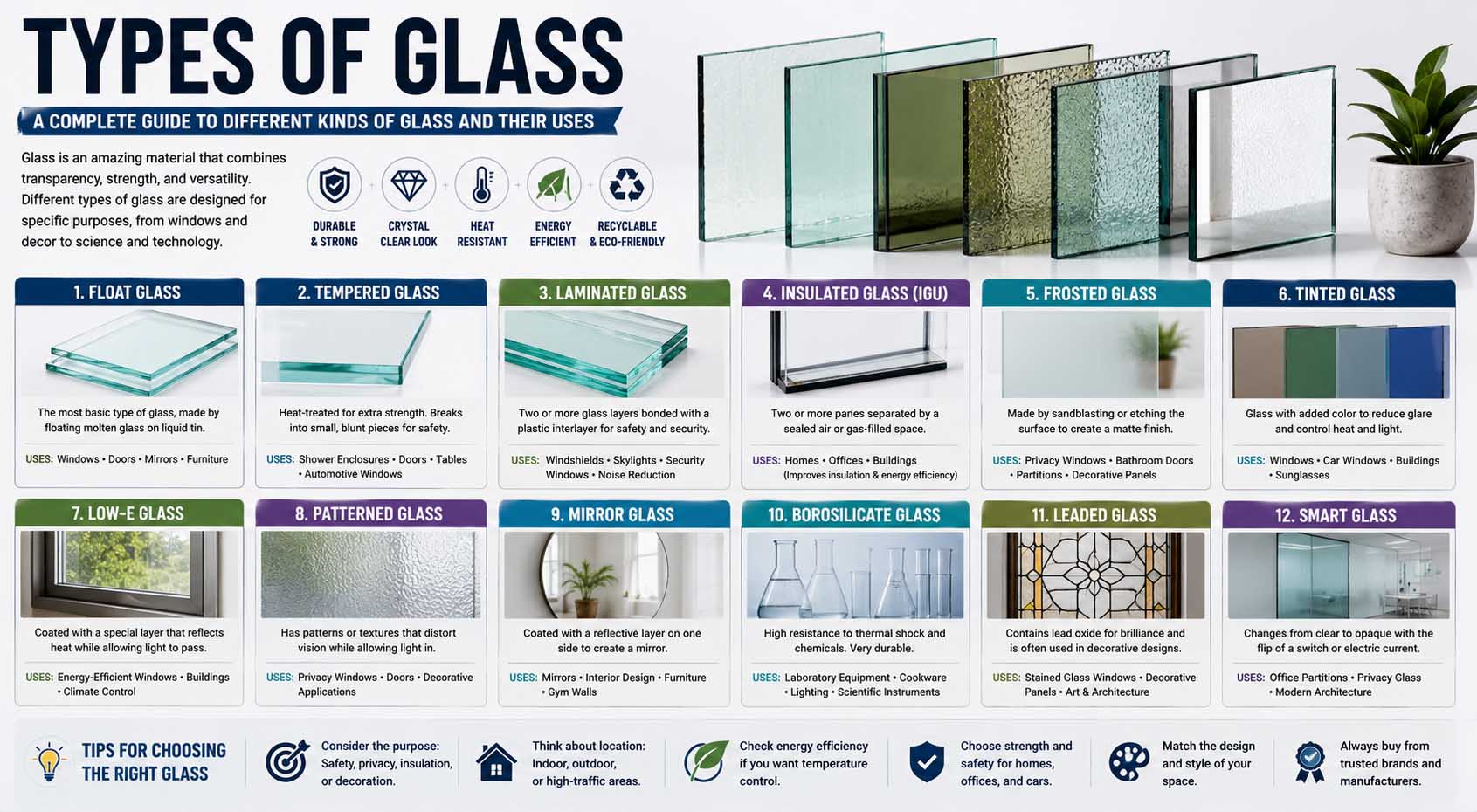
Common Types of Glass at a Glance
Before choosing a product, it helps to understand how the most common options differ.
| Glass type | Key characteristic | Common uses |
|---|---|---|
| Annealed glass | Standard untreated glass | Picture frames, some interior applications |
| Tempered glass | Heat-treated for greater strength and safer breakage | Doors, shower enclosures, furniture |
| Laminated glass | Layers bonded with an interlayer | Security glazing, windows, skylights |
| Insulated glass | Two or more panes separated by a sealed space | Exterior windows and doors |
| Low-E glass | Special coating controls heat transfer and radiant energy | Energy-efficient windows |
| Tinted glass | Reduces some visible light and solar heat | Windows, doors, decorative uses |
| Frosted glass | Obscures visibility | Bathrooms, doors, privacy panels |
| Patterned glass | Textured or decorative surface | Cabinets, doors, decorative windows |
| Wired glass | Wire mesh embedded in glass | Certain specialized fire-rated applications |
However, these categories can overlap. For instance, an insulated window unit may contain tempered, laminated, tinted, or low-E panes.
Types of Glass for Everyday Home Projects
Annealed Glass
Annealed glass is standard glass that has been slowly cooled after manufacturing. It is widely used as a base product before further processing.
Its main advantage is affordability and versatility. However, when it breaks, it can form large, sharp pieces. Therefore, building codes may restrict its use in locations where safety glazing is required.
For low-risk decorative applications, annealed glass can still make sense. Nevertheless, shoppers should confirm whether their intended installation requires a safety-rated alternative.
Tempered Glass
Tempered glass undergoes controlled heating and rapid cooling. Consequently, it becomes stronger than ordinary annealed glass of similar thickness.
More significantly for safety applications, tempered glass is designed to break into many relatively small pieces rather than large sharp shards.
For that reason, it commonly appears in shower enclosures, doors, certain windows, glass tables, shelving, and other locations where safety matters.
Tempered glass generally cannot be cut or drilled after tempering. Therefore, measure carefully and specify holes, notches, and dimensions before ordering a custom panel.
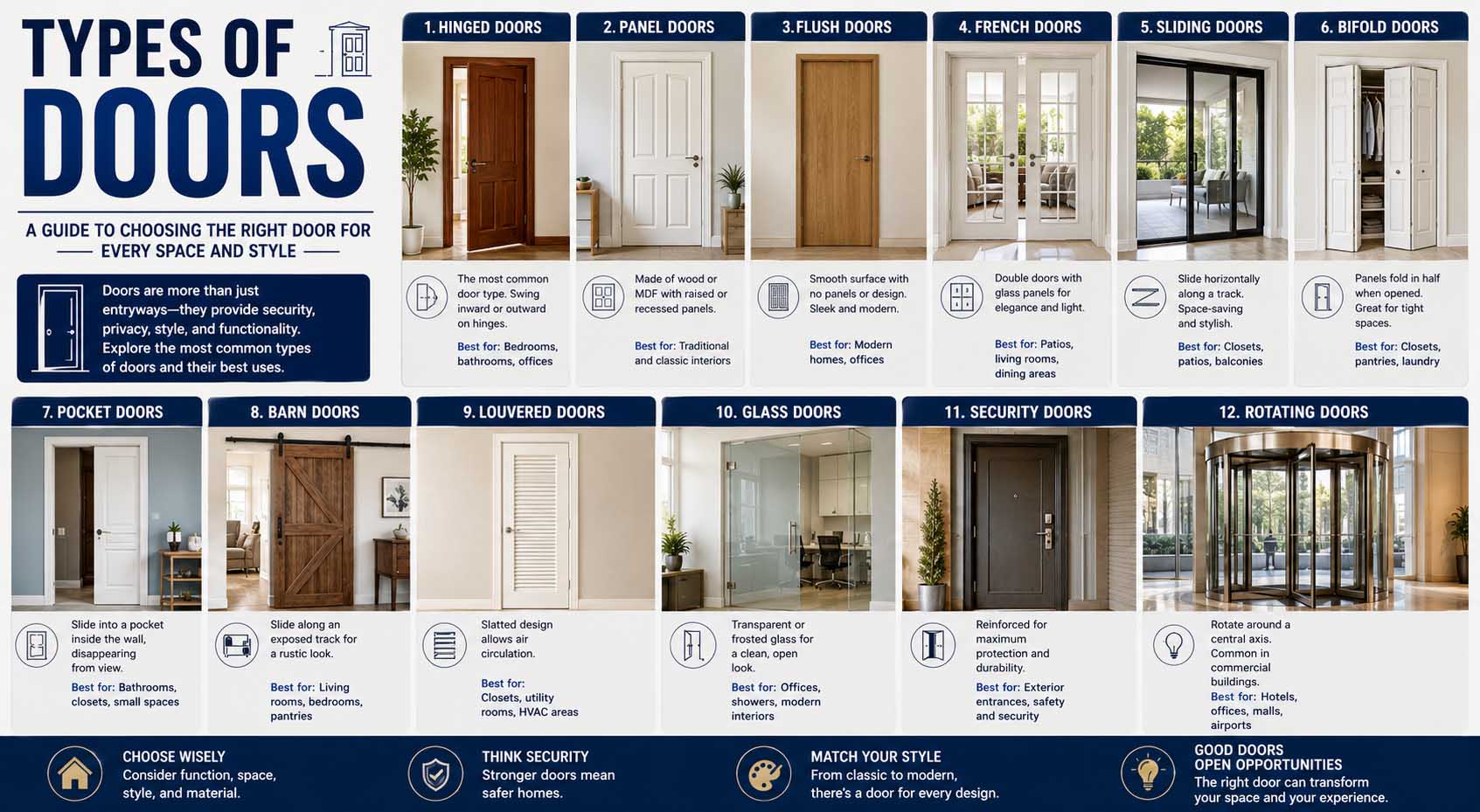
When researching types of doors, you will often see tempered safety glass used in patio, entry, shower, and full-view door designs.
Laminated Glass for Safety and Security
Laminated glass consists of two or more pieces of glass bonded around an interlayer, commonly made from a plastic material such as polyvinyl butyral (PVB).
If the glass breaks, the interlayer helps hold fragments together. As a result, laminated glass can provide useful safety and security characteristics.
It is commonly used in vehicle windshields and can also appear in residential windows, doors, overhead glazing, and applications requiring greater resistance to glass fallout.
However, laminated glass should not automatically be treated as burglar-proof or impact-proof. Performance varies according to the glass thickness, interlayer, construction, framing system, and applicable product rating.
Therefore, if security or storm protection is your main goal, look for products tested specifically for the performance level you need rather than relying on the word “laminated” alone.
Types of Window Glass Worth Comparing
Choosing among the types of window glass involves more than deciding between clear and tinted panes. Exterior windows form part of the building envelope, so thermal performance can significantly affect comfort and energy use.
Insulated Glass Units
An insulated glass unit, often called an IGU, normally uses two or more panes separated by a sealed space.
The space between panes may contain air or an insulating gas such as argon. Meanwhile, spacers and seals maintain separation between the panes.
Double-pane and triple-pane windows use this general construction.
Because performance depends on the entire window, however, glass is only one factor. Frame design, spacers, coatings, gas fill, installation quality, and air leakage also affect efficiency.
If you are comparing the many types of windows available for a renovation, evaluate whole-window ratings rather than judging energy performance only by the number of glass panes.
Low-E Glass
Low-emissivity, or low-E, glass has a microscopically thin coating designed to reduce certain forms of radiant heat transfer while still allowing useful visible light through.
Different low-E coatings suit different climates and orientations. Therefore, a coating that works well for one house may not be the ideal choice for another.
When shopping, compare performance ratings such as U-factor and solar heat gain coefficient where applicable. These measurements provide more useful information than marketing phrases such as “energy-saving glass.”
Frosted and Patterned Glass for Privacy
Sometimes, the buyer’s priority is privacy rather than insulation.
Frosted glass diffuses light and makes objects on the opposite side less clearly visible. Manufacturers can create the effect through methods such as acid etching, sandblasting, or applied films.
As a result, frosted glass works particularly well for bathroom windows, shower areas, office partitions, and certain interior doors.
Patterned or textured glass offers a similar advantage while adding a decorative surface. Available designs range from subtle textures to bold geometric patterns.
However, privacy levels differ considerably. Therefore, if complete visual screening matters, inspect a sample from both sides and under different lighting conditions before ordering.
Tinted and Reflective Glass
Tinted glass contains color that changes its appearance and can reduce some solar heat gain and visible light transmission.
Common shades include gray, bronze, blue, and green. Consequently, tinted glass can change both exterior appearance and interior lighting.
Reflective glass uses a coating that creates a more mirror-like exterior appearance under suitable lighting conditions. It is common in commercial architecture, although some residential products also use reflective technologies.
Keep in mind that darker does not automatically mean more energy efficient. Instead, compare actual product performance data if solar control is your main concern.
Glass for Eyewear Works Differently
The word glass also appears in eyewear discussions, although modern eyeglass and sunglass lenses may use glass or various plastics.
For sunglasses, lens material and polarization describe different characteristics. Polarization involves a filter designed to reduce glare from certain reflective surfaces, while the underlying lens may be made from several materials.
Therefore, shoppers interested in outdoor eyewear should consider the benefits of polarized sunglasses separately from the material used to manufacture the lenses.
Likewise, understanding the difference between polarized and non polarized sunglasses helps buyers evaluate glare reduction rather than assuming every dark lens provides the same visual experience.
This distinction is useful because “glass” can refer broadly to glazing, glassware, and eyewear even though the product requirements differ substantially.
Decorative and Specialty Glass Options
Colored Glass
Colored glass can create an architectural accent in cabinets, doors, partitions, lighting fixtures, and decorative panels.
Color may come from ingredients added during manufacturing, coatings, films, or other processes. Therefore, durability and appearance can vary between products.
Ask whether the color is part of the glass or a surface treatment, particularly for areas exposed to cleaning, moisture, or sunlight.
Mirrored Glass
Mirrored glass usually consists of a glass sheet with a reflective backing or coating.
Besides conventional wall mirrors, manufacturers offer tinted, antiqued, and decorative mirrored finishes. However, installation location matters because moisture and unsuitable adhesives can damage some mirror backings.
Smart Glass
Switchable or smart glass can change its optical properties using electrical or other technologies. For example, some products can switch between clearer and more privacy-oriented states.
Smart glass can be appealing for high-end bathrooms, meeting rooms, partitions, and modern homes. Yet it generally costs much more than basic privacy glass or film.
Therefore, compare the convenience with simpler alternatives before buying.
What About Types of Glass Pipes?
The phrase types of glass pipes can describe glass tubing and piping used in laboratory, industrial, scientific, or specialty equipment.
Borosilicate glass is especially well known for applications that require better resistance to thermal shock than ordinary soda-lime glass. Meanwhile, specialized glass compositions may be chosen for particular chemical, optical, or temperature requirements.
However, shoppers should select technical glass according to the intended application and manufacturer specifications. Thickness alone does not determine chemical or heat resistance.
For laboratory or industrial projects, verify pressure, temperature, chemical compatibility, and relevant safety requirements before purchasing.
Types of Sliding Glass Door Locks and Glass Selection
When buying or replacing a sliding glass door, the glazing and lock system should be considered separately.
Common types of sliding glass door locks include mortise-style locks, hook locks, keyed handles, auxiliary locks, and other secondary security devices. However, compatibility depends on the specific door frame and hardware design.
Meanwhile, the door glass itself may be tempered, laminated, insulated, low-E, or a combination of these technologies.
Therefore, replacing the lock does not change the safety characteristics of the glass. Similarly, upgrading the glass does not compensate for damaged or poorly functioning door hardware.
For replacement projects, identify the door manufacturer and model when possible before ordering either component.
How to Choose the Right Type of Glass
Start with the installation location rather than appearance.
First, determine whether building codes require safety glazing. Doors, bathrooms, stairs, low windows, and other hazardous locations may have specific requirements depending on local regulations.
Next, decide what performance matters most. For exterior glazing, energy efficiency may be a priority. Meanwhile, bathrooms may require privacy, and vulnerable locations may benefit from appropriate safety or security glazing.
Then, compare thickness and dimensions. Larger glass panels may require different specifications than small decorative pieces.
After that, consider maintenance. Clear glass can show fingerprints and water spots, while deeply textured surfaces may take more effort to clean.
Finally, obtain quotes for the complete project. Custom cutting, edge finishing, tempering, laminating, coatings, delivery, hardware, and professional installation can all affect the final price.
Common Glass-Buying Mistakes
One frequent mistake is choosing glass based entirely on appearance. Although a panel may look perfect, it may not satisfy safety or performance requirements for the intended location.
Another mistake is ordering tempered glass before confirming measurements. Since finished tempered glass generally cannot be resized, a measurement error can mean ordering an entirely new panel.
Likewise, shoppers sometimes assume all double-pane windows provide identical insulation. In reality, coatings, spacers, gas fills, frames, and construction quality can create meaningful differences.
Finally, avoid using the terms tempered, laminated, and insulated interchangeably. Each describes a different feature, and one product can sometimes combine several of them.
FAQs About Types of Glass
What are the most common types of glass?
Common choices include annealed, tempered, laminated, insulated, low-E, tinted, frosted, patterned, and mirrored glass. However, the best option depends on the application.
What type of glass is best for windows?
There is no universal best option. Many modern exterior windows use insulated glass units, often combined with low-E coatings. Climate, orientation, local codes, budget, and whole-window performance should guide the decision.
Is tempered glass better than regular glass?
Tempered glass provides greater strength and safer breakage characteristics than ordinary annealed glass, making it suitable or required for many safety applications. However, standard glass may still work for certain low-risk uses.
Is laminated glass the same as tempered glass?
No. Tempered glass receives heat treatment, while laminated glass bonds layers together with an interlayer. Both can improve safety, but they behave differently when broken.
Which glass is best for privacy?
Frosted, patterned, tinted, and certain smart-glass products can provide varying levels of privacy. However, lighting conditions can affect visibility, so compare actual samples before buying.
Choose Glass for the Job, Not Just the Look
The different types of glass make it possible to match the material closely to the job. Tempered glass can make sense where safety glazing is needed, while laminated products offer different breakage and security characteristics. Meanwhile, insulated and low-E glazing can improve the performance of exterior windows, while frosted and patterned options provide privacy without completely blocking natural light.
Before placing an order, confirm dimensions, local safety requirements, installation conditions, and the exact product specification. Then compare complete project costs rather than the glass price alone. By matching the product to its real purpose, you are far more likely to buy glass that performs well and remains suitable for the space over the long term.