
Types of Saws: A Practical Guide to Choosing the Right Saw
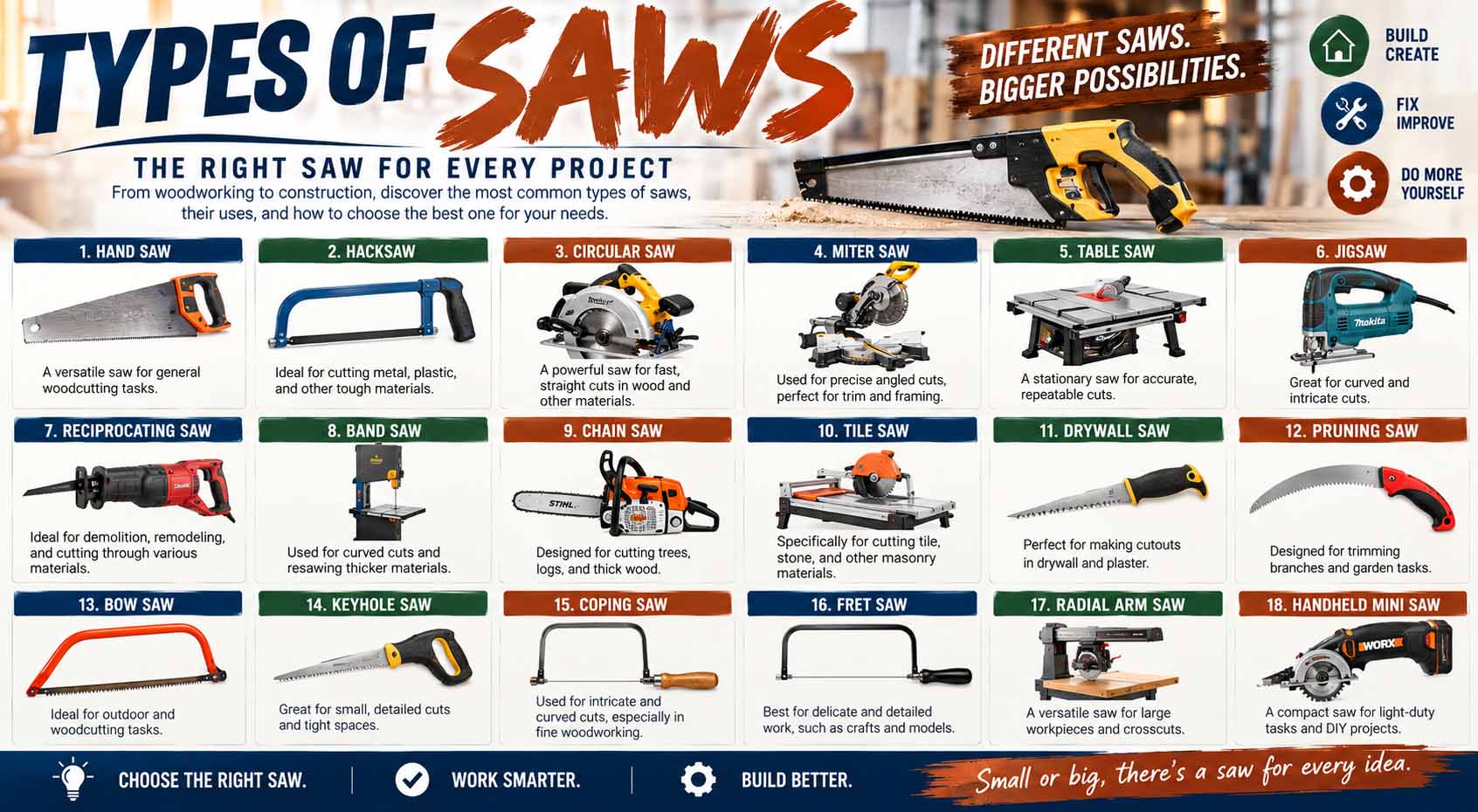
Choosing a saw becomes much easier once you know what each design is meant to cut. The many types of saws range from simple hand tools for occasional DIY jobs to powerful electric machines designed for fast, accurate cutting. Some work best on lumber, while others handle plywood, metal, plastic, drywall, or demolition work. Therefore, instead of buying the biggest or most powerful model, it makes more sense to choose a saw based on the material, cut style, portability, and accuracy your projects require.
How the Different Types of Saws Compare
Most saws fall into two broad groups: hand saws and power saws.
Hand saws rely on physical movement, so they are affordable, portable, and useful for smaller jobs. Power saws use electricity or batteries and generally make repeated or demanding cuts much faster.
However, power is not always better. For instance, a handsaw may be more convenient when you need one quick cut, while a miter saw makes far more sense when cutting dozens of boards to consistent lengths.
Here is a quick comparison:
| Saw Type | Best For | Power Source | Typical Buyer |
|---|---|---|---|
| Hand saw | General wood cutting | Manual | Homeowner, beginner |
| Circular saw | Straight cuts in boards and sheet goods | Corded/battery | DIYer, contractor |
| Jigsaw | Curves and detailed shapes | Corded/battery | DIYer, craft user |
| Miter saw | Crosscuts and angled cuts | Electric | Woodworker, remodeler |
| Table saw | Accurate rip cuts | Electric | Workshop user |
| Reciprocating saw | Demolition | Corded/battery | Remodeler, contractor |
| Band saw | Curves and workshop cutting | Electric | Woodworker |
| Coping saw | Small curved cuts | Manual | Trim and craft user |
| Hacksaw | Metal and plastic | Manual | General DIY user |
| Drywall saw | Cutting drywall openings | Manual | Renovator |
The right choice depends heavily on what you plan to build, repair, or remodel.
Types of Hand Saws for Home and Workshop Use
Although power tools dominate many workshops, types of hand saws remain useful because they are inexpensive, easy to carry, and require no battery or electrical outlet.
Traditional Hand Saw
A standard hand saw is designed primarily for cutting wood. Its broad blade and comfortable handle make it useful for trimming lumber, cutting boards, and handling general household jobs.
For occasional DIY work, this may be the only manual wood saw you need.
Backsaw
A backsaw has a reinforced upper edge that keeps the blade relatively rigid. As a result, it works well when accuracy matters more than cutting speed.
Many miter boxes use backsaws because the stiff blade helps produce controlled crosscuts and angled cuts.
Coping Saw
A coping saw has a thin, narrow blade held inside a metal frame. Because the blade can follow tight curves, the tool works well for trim, decorative pieces, and detailed woodworking.
It is inexpensive, although cutting larger pieces with one would be slow.
Hacksaw
Hacksaws usually have fine-toothed blades designed for cutting metal. However, the correct blade can also cut certain plastics and other materials.
Therefore, a hacksaw is a useful addition to a basic household toolkit.
Drywall Saw
A drywall saw, sometimes called a jab saw, has a narrow pointed blade. Its shape lets you start openings in drywall for electrical boxes, plumbing access, and similar projects.
For homeowners learning how to patch drywall, owning a basic drywall saw can also be useful when damaged material must be cut back to create a clean repair area.
Types of Power Saws Worth Considering
The various types of power saws solve different cutting problems. Therefore, buyers should focus on the jobs they actually perform instead of collecting tools that overlap heavily.
Circular Saw
A circular saw is one of the most versatile power saws for home improvement.
Its round spinning blade makes fast straight cuts through lumber, plywood, and many sheet materials when fitted with the appropriate blade. Meanwhile, adjustable cutting depth and bevel settings make it flexible enough for many construction projects.
A cordless circular saw offers better mobility, while a corded model provides continuous power without battery management.
For many DIY buyers, a circular saw offers one of the best combinations of price, portability, and usefulness.
Jigsaw
A jigsaw uses a narrow reciprocating blade rather than a circular one. Consequently, it can follow curved lines and cut openings that would be difficult with a circular saw.
Jigsaws are commonly used on wood, laminate, plastic, and some metals when paired with the correct blade.
They are especially useful for buyers who make furniture, decorative projects, countertop openings, or curved shapes.
Miter Saw
A miter saw excels at crosscuts and angled cuts.
For example, it is particularly convenient for molding, trim, framing components, flooring, and other jobs where several boards must be cut consistently.
A sliding compound miter saw increases cutting capacity. However, it also costs more and requires additional workspace, so casual users should consider whether they genuinely need the extra range.
Table Saw
A table saw positions a circular blade through a flat work surface. With a properly adjusted fence, it can make consistent rip cuts along the length of boards and sheet goods.
Therefore, it is a valuable workshop tool for furniture building, cabinetry, and repeated woodworking.
However, table saws occupy more space than handheld tools. Buyers also need to understand safe setup and operating procedures before using one.
Best Types of Saws for Wood
The best types of saws for wood depend on the cut rather than simply the material.
For rough manual cutting, a traditional hand saw works well. Meanwhile, a circular saw is usually more efficient for construction lumber and sheet goods.
A table saw excels at repeated straight cuts, while a miter saw handles accurate crosscuts and angles. In contrast, a jigsaw or band saw makes more sense for curved work.
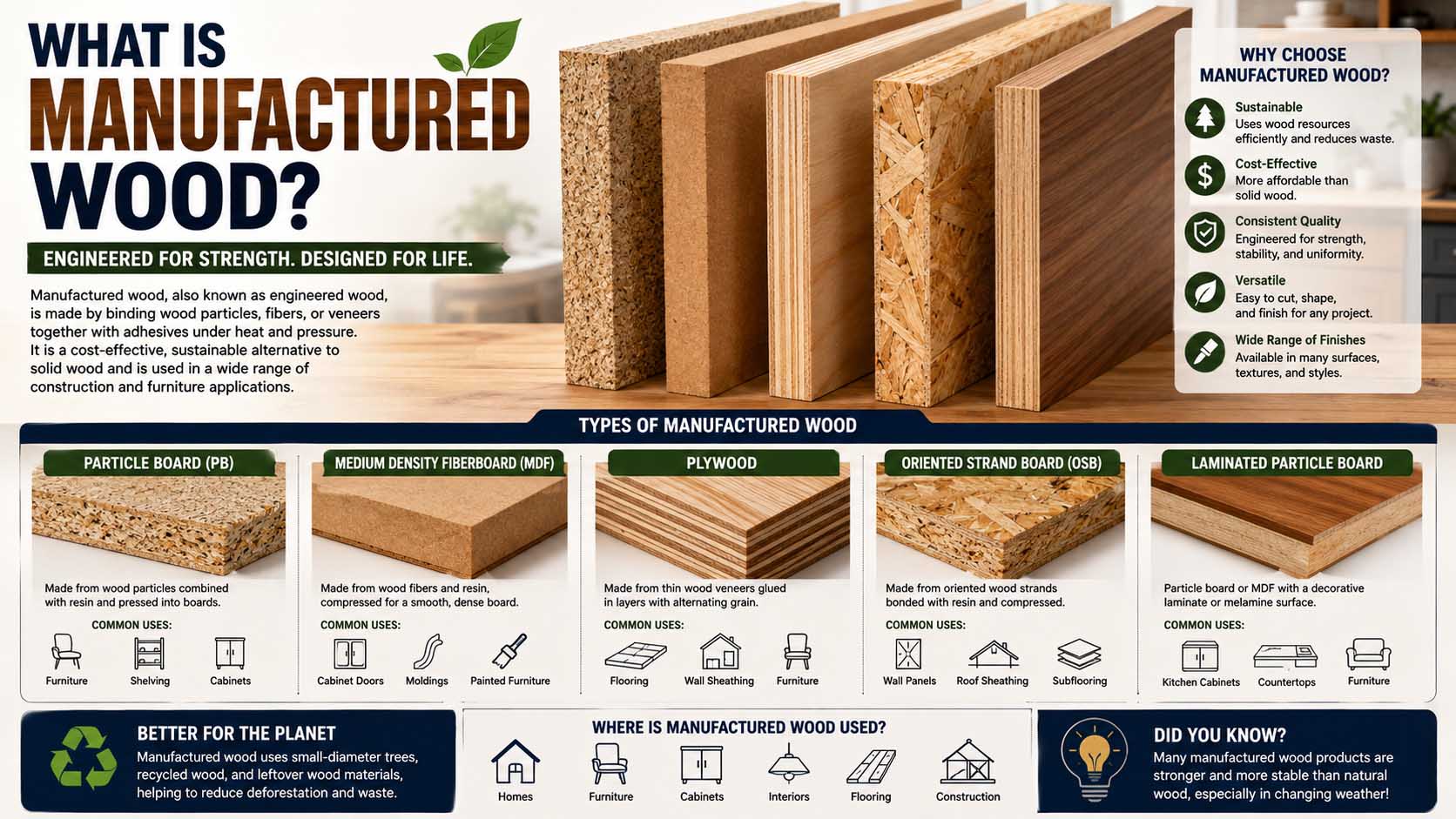
Material composition also matters. If you regularly cut composite panels or furniture boards, understanding what is engineered wood can help you choose blades suited to plywood, MDF, OSB, and similar products rather than treating every wood-based panel like solid lumber.
Blade selection matters just as much as the saw itself. For example, a blade intended for rough framing may cut quickly but leave a rougher edge, while a fine-tooth blade can provide a cleaner finish.
Reciprocating Saws for Renovation and Demolition
A reciprocating saw moves a long blade rapidly backward and forward. Unlike a miter or table saw, it focuses more on access and speed than precision.
That makes it excellent for demolition.
With the appropriate blade, users can cut wood, nails, plastic pipe, and certain metals. Therefore, contractors often use reciprocating saws when removing old framing, fixtures, or damaged building materials.
They can also be useful during remodeling projects involving old types of doors, particularly when frames, fasteners, or surrounding materials need to be removed before replacement.
However, buyers looking primarily for clean woodworking cuts should choose another tool. A reciprocating saw is designed to work aggressively rather than produce furniture-quality edges.
Band Saws and Scroll Saws for Detailed Work
Band saws and scroll saws both handle curved cutting, although they serve different users.
A band saw uses a continuous loop blade running between wheels. As a result, it can cut curves while also handling thicker pieces of wood than many jigsaws.
Woodworkers may use band saws for resawing, shaping furniture parts, or creating curved components.
A scroll saw, by comparison, specializes in intricate detail. Its thin blade makes tight curves and internal cutouts possible, which makes it popular for decorative woodworking, patterns, and craft projects.
If you are learning how to frame a canvas, you probably do not need either specialized machine for basic frame cuts. A miter saw or even a miter box with a suitable hand saw is usually more practical for making clean 45-degree frame joints.
What Saw Works Best for Manufactured Wood?
Many furniture and home-improvement projects use wood-based panels rather than solid timber.
If you are researching what is manufactured wood, you will find materials such as MDF, particleboard, and various composite panels commonly used in furniture and interior projects.
A circular saw or table saw can cut many of these materials effectively when fitted with a suitable blade. However, cleaner cuts usually require blades with more teeth than those intended for fast rough construction cuts.
Supporting the panel properly also matters. Otherwise, large sheets can shift, pinch the blade, or produce uneven edges.
For occasional cuts, a circular saw paired with a straightedge guide can be practical. Meanwhile, frequent workshop users may prefer a table saw or track saw for better repeatability.
Track Saw vs Circular Saw
A track saw resembles a circular saw but rides along a guide rail.
As a result, it can produce long, controlled straight cuts in plywood and other sheet materials. It is particularly attractive to cabinetmakers, furniture builders, and users who want precise sheet cutting without dedicating floor space to a large table saw.
However, track saw systems generally cost more than basic circular saws.
Therefore, occasional DIY users may get better value from a circular saw and guide. Frequent sheet-goods users, though, may find the extra precision and convenient setup worth paying for.
How to Choose the Right Saw
Before buying, start with the material you cut most often.
If most projects involve basic lumber and plywood, a circular saw may provide enough versatility. However, someone installing trim regularly could benefit more from a miter saw.
Next, consider these factors:
Cut type: Decide whether you mainly make straight cuts, crosscuts, curves, angles, or demolition cuts.
Material: Wood, metal, plastic, masonry, and composite materials may require different saws and blades.
Portability: Cordless saws are convenient on job sites and around the home, although batteries add cost.
Accuracy: Workshop tools such as table saws and miter saws generally make repeated precision work easier.
Available space: A large stationary saw makes little sense if you have nowhere practical to store and operate it.
Frequency of use: An occasional homeowner may not need professional-grade equipment designed for daily job-site use.
Prices vary significantly depending on saw type, power, blade capacity, battery platform, features, brand, retailer, and location. Therefore, compare the features you will actually use rather than choosing solely by price.
Blade Choice Matters More Than Many Buyers Expect
Buying the correct saw is only half of the decision. The blade determines much of the tool’s actual cutting performance.
For example, coarse-tooth wood blades typically cut quickly, while fine-tooth blades often create smoother edges. Meanwhile, metal-cutting applications require blades designed for the material and saw.
Always check the manufacturer’s blade specifications, including diameter, arbor size, speed rating, and compatible materials.
Likewise, replace damaged or excessively worn blades instead of pushing them through another project. A properly maintained saw with an appropriate sharp blade generally provides more controlled results than a powerful saw fitted with the wrong cutting accessory.
Common Saw-Buying Mistakes
One common mistake is buying too much tool. A large table saw may look appealing, yet it can become an expensive storage problem if you only make occasional household cuts.
Another mistake is buying solely according to motor power. Accuracy, ergonomics, blade availability, dust collection, cutting capacity, and ease of adjustment can matter just as much.
Also, consider the wider tool system when purchasing cordless equipment. If you already own compatible batteries from one platform, buying another compatible saw may reduce the total cost.
Finally, do not use one blade for every material simply because it physically fits the tool. Always use a blade rated for the saw and intended for the material being cut.
Frequently Asked Questions
What are the most useful types of saws for beginners?
A basic hand saw, circular saw, and jigsaw cover many household and DIY projects. However, the best combination depends on whether you work mainly with lumber, sheet goods, crafts, or home repairs.
Which saw is best for straight cuts?
Circular saws are excellent portable options for straight cuts. Meanwhile, table saws offer strong repeatability in a workshop, and track saws are particularly useful for precise cuts through large sheet materials.
Which saw is best for cutting curves?
A jigsaw is usually the most practical choice for general DIY curved cuts. However, band saws and scroll saws offer specialized capabilities for workshop and detailed woodworking.
Do I need a miter saw and a circular saw?
Not necessarily. A circular saw handles a wider variety of portable cutting jobs, while a miter saw makes repeated crosscuts and angles faster and easier. Therefore, buy both only when your projects benefit from their different strengths.
Are cordless saws better than corded saws?
Neither is automatically better. Cordless saws offer excellent portability, while corded models provide continuous operation without waiting for batteries. Your work location and usage frequency should guide the choice.
Choosing a Saw You Will Actually Use
The many types of saws may look confusing at first, but each one becomes easier to understand when you focus on the cut it performs best. A circular saw is a strong general-purpose choice, while a jigsaw handles curves, a miter saw specializes in crosscuts and angles, and a reciprocating saw suits demolition.
Therefore, start with your most common projects instead of trying to build a complete workshop immediately. Choose a saw with enough cutting capacity for those jobs, pair it with the correct blade, and follow the manufacturer’s operating and safety instructions. As your projects become more specialized, you can add tools that solve specific cutting problems rather than buying equipment you rarely use.