
Types of Paint: A Practical Guide to Choosing the Right Paint and Finish
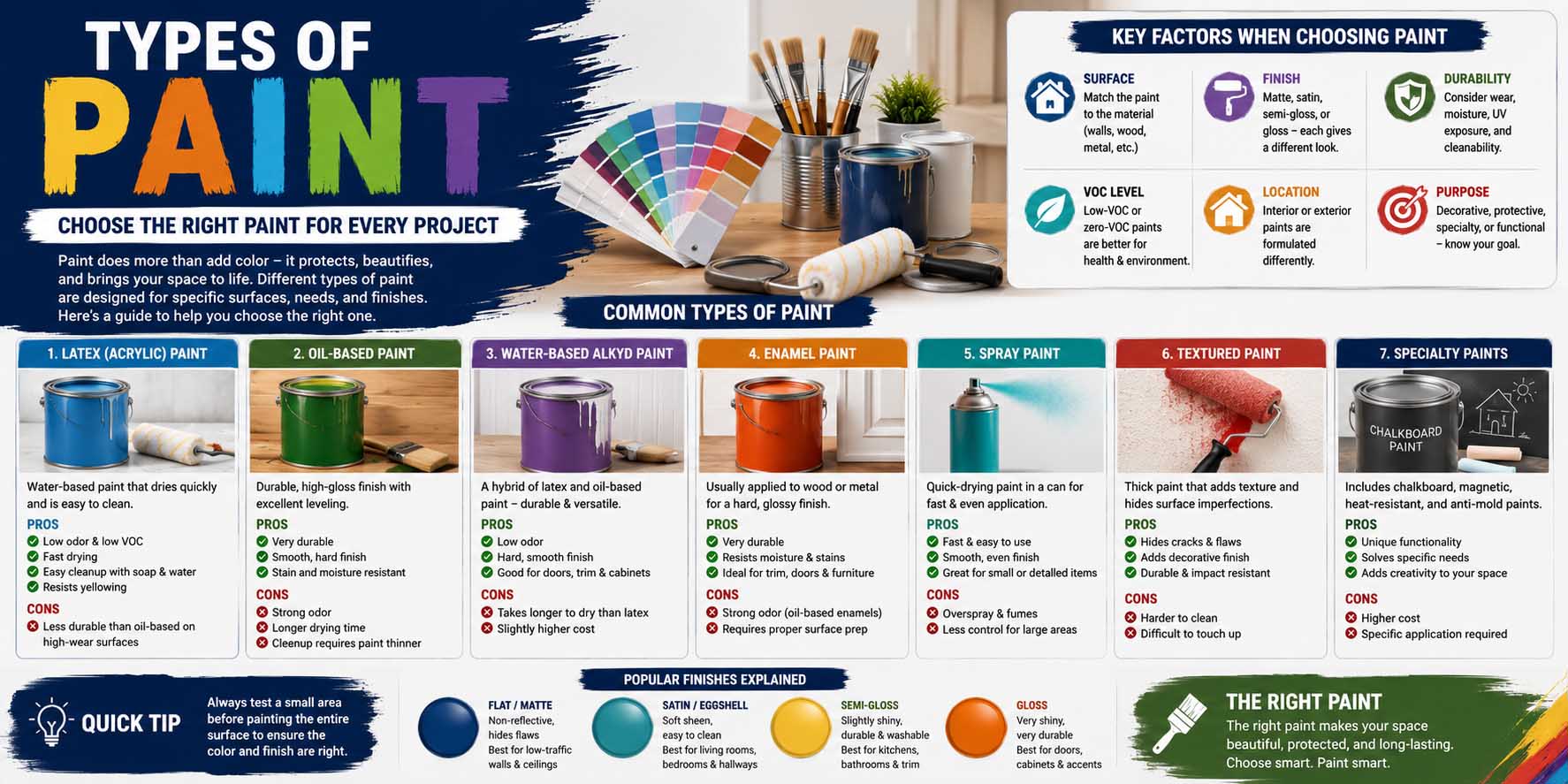
Walk into a paint aisle and the number of choices can make a simple weekend project surprisingly confusing. The many types of paint differ in formulation, finish, durability, cleanup, and the surfaces they suit best. For most indoor walls, water-based latex or acrylic paint is a practical choice, while trim, cabinets, exterior surfaces, masonry, and specialty projects may require products designed specifically for those jobs.
Choosing well involves more than picking a color. You also need to consider moisture, traffic, surface material, cleaning requirements, and the appearance you want after the paint dries. Fortunately, once you understand a few basic differences, comparing paint products becomes much easier.
Quick Comparison of the Main Types of Paint
Paint terminology can vary between manufacturers. However, most household products fall into several broad categories.
| Paint Type | Common Uses | Main Advantage | Main Consideration |
|---|---|---|---|
| Water-based latex | Walls and ceilings | Easy cleanup and broad availability | Quality varies |
| Acrylic | Interior and exterior surfaces | Good durability and adhesion | Often costs more than basic latex |
| Oil-based/alkyd | Trim and specialty surfaces | Hard, smooth finish | Longer drying and more involved cleanup |
| Enamel | Doors, trim, cabinets | Durable finished surface | Product formulas vary |
| Masonry paint | Brick, concrete, masonry | Designed for mineral surfaces | Surface preparation matters |
| Chalk-style paint | Furniture and décor | Distinctive matte appearance | May need a protective topcoat |
| Primer | Surface preparation | Helps prepare problem surfaces | Not a substitute for finish paint |
Always check the manufacturer’s label before purchasing. Products that look similar on the shelf may have different surface requirements, drying times, coverage, and application instructions.
Water-Based Latex Paint
Water-based latex is one of the most common choices for interior painting. Despite the name, modern latex paint generally uses synthetic binders rather than natural rubber latex.
It is popular because cleanup is usually simple with soap and water. Likewise, many formulas dry relatively quickly and produce less odor than traditional solvent-heavy alternatives.
For bedrooms, living rooms, hallways, and ceilings, water-based wall paint is often the easiest starting point for a DIY buyer. However, choose the appropriate quality level and sheen for the room rather than simply buying the cheapest can.
Surface preparation also matters. For example, holes, dents, and damaged areas should be repaired before painting. If your wall needs repair first, learning how to patch drywall can help you create a smoother surface before primer and paint go on.
Acrylic Paint for Interior and Exterior Projects
Acrylic paints use acrylic resin as a binder and are widely available in household coatings. Depending on the formulation, they can offer good adhesion, flexibility, and resistance to weathering.
Exterior acrylic paint is particularly common because outside walls face sunlight, moisture, and temperature changes. Still, not every acrylic product is suitable for every exterior material.
Inside the home, acrylic-based products are also used on walls, trim, furniture, and other surfaces. Therefore, the label is more useful than the general term “acrylic” when deciding whether a particular can fits your project.
When shopping, check whether the paint is rated for interior, exterior, or interior/exterior use. Then, confirm compatibility with wood, drywall, masonry, metal, or whichever material you plan to cover.
Oil-Based and Alkyd Paint
Traditional oil-based paint has long been valued for its smooth leveling and hard finish. As a result, it has often been used on doors, trim, woodwork, and other surfaces that need durability.
However, oil-based products usually take longer to dry than water-based paints. Cleanup can also require mineral spirits or another manufacturer-recommended solvent rather than ordinary soap and water.
Modern waterborne alkyd products offer another option. These coatings aim to provide some of the smooth application and durable finish associated with traditional alkyd paint while allowing easier cleanup in many formulations.
For cabinets in particular, formulation matters because kitchen surfaces receive frequent contact and cleaning. A guide to the best paint for cabinets can help you compare products designed to handle those demands rather than relying on ordinary wall paint.
Primer Is Different From Finish Paint
Primer prepares a surface so the finish coat can perform properly. For instance, it can help with adhesion, seal porous material, or block certain stains depending on the specific primer.
New drywall, bare wood, patched areas, stains, drastic color changes, and some glossy surfaces may benefit from an appropriate primer.
However, one primer does not solve every problem. A stain-blocking product, bonding primer, masonry primer, and drywall primer serve different purposes.
Paint-and-primer products can be convenient on suitable previously painted surfaces. Still, they do not eliminate the need for specialized primer when the substrate or condition requires one.
Therefore, inspect the surface before shopping instead of assuming every project needs the same preparation.
Types of Paint Finishes Explained
After choosing a paint formulation, you also need a sheen. The main types of paint finishes range from very flat surfaces to highly reflective gloss.
Higher sheen generally makes imperfections more noticeable. On the other hand, many higher-sheen products offer better resistance to cleaning and handling, although performance varies by formula.
Flat and Matte
Flat and matte paints reflect little light. Consequently, they can help disguise minor surface imperfections and provide a soft, understated appearance.
They are commonly used on ceilings and lower-traffic walls. However, some traditional flat paints are less resistant to scrubbing than higher-sheen products.
Modern washable matte formulations can perform better, so compare the specific product specifications instead of judging by sheen alone.
Eggshell
Eggshell has a subtle sheen that sits between matte and satin. Because it balances appearance with practical durability, many homeowners choose it for living rooms, bedrooms, dining areas, and hallways.
It usually reflects enough light to feel slightly more polished than flat paint without creating a shiny wall.
Satin
Satin offers a noticeable but restrained sheen. Therefore, it is often selected for busy spaces, including hallways, family rooms, children’s rooms, and some kitchens or bathrooms.
Because formulations differ, look specifically for moisture resistance or washability when those features matter.
Semi-Gloss
Semi-gloss reflects more light and creates a harder-looking finish. It is commonly used on trim, doors, baseboards, and other surfaces that need regular wiping.
However, its reflective surface can highlight dents, sanding marks, and other flaws. Careful preparation becomes more noticeable with this finish.
High-Gloss
High-gloss produces the most reflective appearance of the common household sheens. It can create a striking finish on doors, selected furniture, cabinetry, and architectural details.
Yet it is unforgiving. Therefore, smooth preparation and careful application are especially valuable when using high-gloss paint.
What Are the 5 Types of Paint Finishes?
If you are asking what are the 5 types of paint finishes?, the usual simplified answer is flat or matte, eggshell, satin, semi-gloss, and high-gloss.
Still, manufacturers do not always use identical terminology. For example, one brand may separate flat and matte, while another may offer pearl, low-luster, or soft-gloss finishes between familiar categories.
Consequently, compare sheen samples within the paint brand you plan to buy rather than assuming an eggshell from one manufacturer looks exactly like another.
Specialty Paints for Specific Surfaces
Some projects need more than standard wall paint. Specialty coatings are formulated for particular surfaces, environments, or decorative effects.
Masonry paint, for instance, is intended for surfaces such as concrete, brick, or stucco when compatible with the substrate. Meanwhile, floor coatings are designed to tolerate foot traffic better than ordinary wall paint.
Furniture paints may prioritize adhesion and appearance on wood or previously finished surfaces. Likewise, exterior paints are designed to handle outdoor exposure that interior products are not intended to withstand.
Housing style does not fundamentally change these paint principles. Whether you are updating a traditional property or researching what is a modular home, the surface material and exposure conditions remain more useful for selecting paint than the construction label alone.
Types of Paint Brushes and Rollers
Buying good paint but using the wrong applicator can make the job harder. Fortunately, choosing among the main types of paint brushes is fairly straightforward.
Synthetic-bristle brushes are commonly recommended for water-based coatings because they maintain their shape well when exposed to water. Natural-bristle brushes, meanwhile, have traditionally been used with certain oil-based coatings but generally should not be used with water-based paint.
An angled sash brush gives you better control around trim, windows, corners, and edges. A flat brush, by comparison, works well on broader surfaces.
Rollers are more efficient for large walls and ceilings. However, nap length matters. Smooth surfaces generally use a shorter nap, while textured walls need a longer nap to reach into uneven areas.
Always check the paint manufacturer’s applicator recommendation, especially when working with specialty coatings.
How Much Paint Should You Buy?
Buying too little creates the risk of stopping halfway through a project, while buying far too much wastes money.
Start by measuring the height and width of each wall. Then, calculate the approximate paintable area while accounting for doors and large windows where practical.
Next, check the coverage estimate on the specific product. Coverage varies based on paint formulation, surface texture, porosity, application method, and color change.
Many projects also require two coats for the desired appearance or performance, even when a product advertises strong coverage.
Therefore, calculate from the manufacturer’s stated coverage instead of relying on a universal number.
Different Types of Paint for Different Rooms
The best paint for a bedroom may not be ideal for a bathroom or entryway.
For bedrooms and living areas, appearance and washability usually drive the decision. Eggshell and washable matte products are common choices.
Kitchens and bathrooms, meanwhile, experience moisture, splashes, and frequent cleaning. Consequently, shoppers often benefit from products specifically rated for those environments rather than selecting paint based only on sheen.
Doors and trim face repeated contact, so durability and cleanability become priorities. Semi-gloss, satin, enamel-type, or trim-specific products are common options depending on the desired appearance.
The same idea applies to less conventional homes. For example, someone researching what is a barndominium may encounter large open interiors and mixed building materials, yet each surface still needs a coating compatible with its material and environment.
Common Paint-Buying Mistakes
Buying paint before checking the surface is one of the easiest mistakes to make. Bare wood, new drywall, metal, masonry, and previously painted surfaces can require different preparation.
Likewise, do not choose sheen solely because you like how the sample looks. Consider cleaning, traffic, moisture, and surface imperfections first.
Another mistake is buying based only on the lowest price per gallon. Higher-priced paint is not automatically better for every project, yet coverage, durability, application, and required number of coats can affect overall value.
Finally, avoid assuming color will look identical to a small paper chip. Light direction, bulbs, flooring, furniture, and nearby colors can dramatically change its appearance.
Instead, test a sample in the actual room and view it during both daylight and evening conditions.
FAQs About Types of Paint
Which type of paint is best for interior walls?
Water-based latex or acrylic wall paint works well for many interiors. However, the ideal product depends on the room, surface condition, desired sheen, and cleaning needs.
What paint finish is easiest to clean?
Satin, semi-gloss, and gloss finishes have traditionally been easier to clean than flat finishes. However, modern washable matte products can also offer strong cleaning performance, so check the specific product specifications.
Do I always need primer before painting?
No. Previously painted surfaces in good condition may not always need a separate primer. However, bare surfaces, stains, repairs, difficult substrates, and major color changes may benefit from or require one.
Is expensive paint always worth buying?
Not necessarily. Premium products may offer better coverage, application, or durability in some cases, but project requirements matter more than price alone. Compare specifications and expected coat count before deciding.
How long should paint dry between coats?
Dry and recoat times vary by formulation, humidity, temperature, ventilation, and manufacturer. Therefore, follow the instructions printed on the product rather than using one universal waiting period.
Choose Paint Based on the Surface, Not Just the Color
The easiest way to compare the different types of paint is to start with where the paint will go. First, identify the surface and whether it is indoors or outdoors. Next, consider moisture, traffic, cleaning, and existing surface condition. Then, choose a compatible formulation and the sheen that gives you the right balance of appearance and practicality.
For most interior wall projects, a quality water-based paint is a sensible starting point. Meanwhile, cabinets, trim, masonry, floors, furniture, and exterior surfaces often benefit from more specialized products.
Finally, bring home samples before committing to several gallons. A little extra planning at the beginning can help you choose the right product, finish, and applicator while avoiding unnecessary purchases halfway through the job.